Disclosure: This product is made by the people who run this site. It was tested with a paid account against the same rubric as every other review, and the score is shown the same way. Read it knowing that.
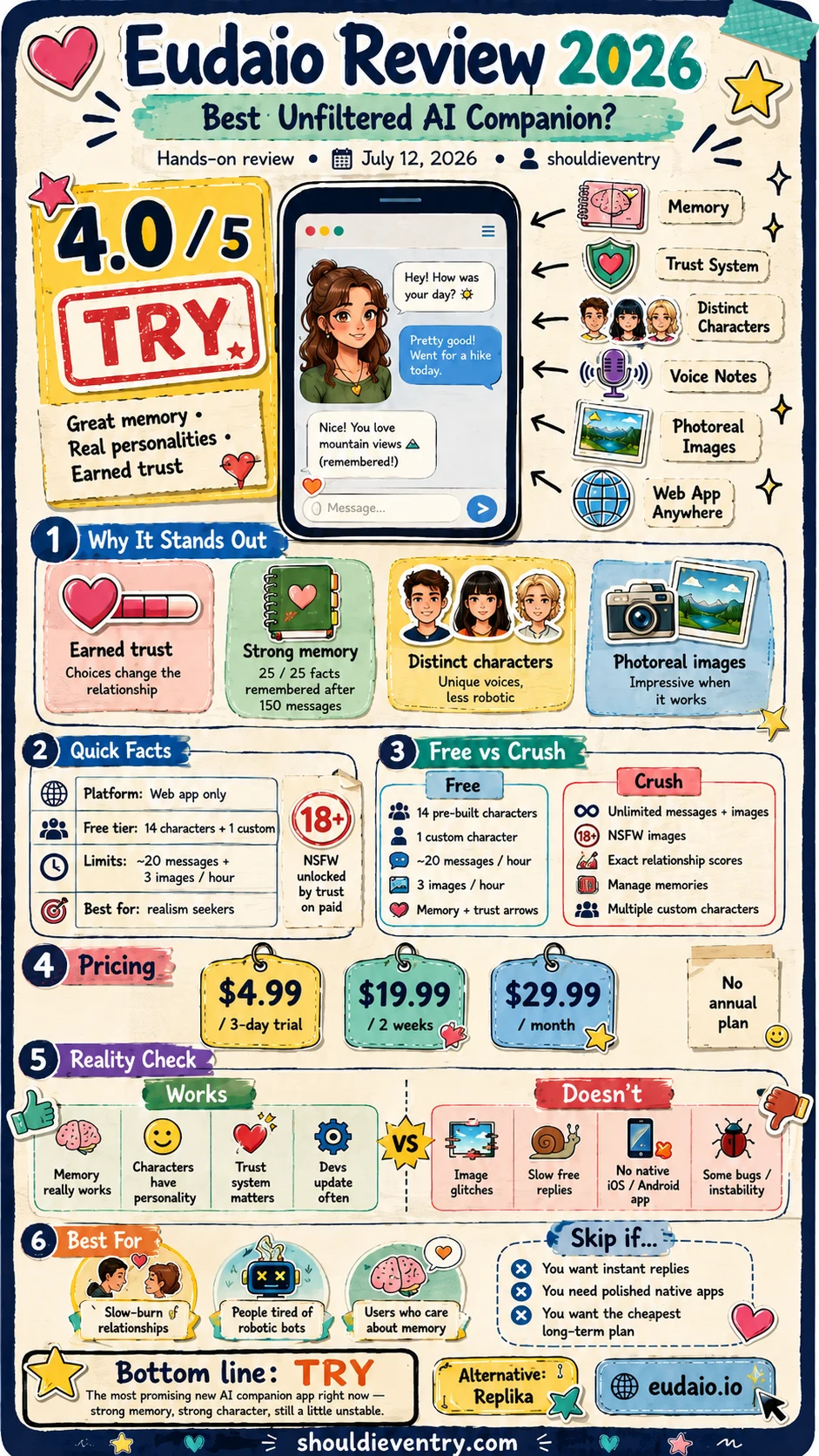
Quick Reference
| Platforms | Web app (no native iOS / Android app, no VR) |
| Free tier | All 14 pre-built characters, 1 custom character, ~20 messages and 3 images per hour |
| Pricing | $4.99 / 3-day trial · $19.99 / 2 weeks · $29.99 / month · $74.99 / 90 days |
| NSFW | Allowed, managed by a trust system related to the character and chat. Goes to full nudity and penetration on paid (not the easiest to achieve) |
| Memory | In depth. 25 of 25 memory facts still stored after 150 messages in the chat; the character recalled them unprompted |
| Best for | Realism seekers who are excited for AI companions to act less robotic, be more integrated into their lives, and are willing to put up with minor instability in the service |
| Verdict | Try. The most promising new ai companion app right now, with some expected instability and bugs that the devs seem to actively be fixing |
Verdict
If you’re in search of the best AI companion app, then for Eudaio, in one word: TRY.
Eudaio is the first AI companion app where the “earned trust” mechanic actually shows up in character behavior. Memory is excellent: after an 8-day silence, a character recalled my city, job, and cat unprompted, and retained ~25 facts across 150 messages. The characters have distinct personalities and gently push back if you move too fast, rather than acting like vending machines. The app is new, runs its own isolated models, and occasionally has reliability issues. Nudity is paywalled, but the free tier is great for testing the slow-burn relationship style.
Image generation has some server glitches and occasional anatomy errors (like an extra arm). When it works, however, the photorealism and character consistency—keeping the same face, clothing, and environment—are genuinely impressive.
Voice messaging was recently added for three characters. It’s a cascaded text-to-speech system rather than real-time voice-to-voice. The quality needs improvement, but the voices fit the characters well, and notes are saved in the chat for playback.
The $4.99 three-day subscription is the low-stakes way to see whether Crush tier is worth $19.99 for two weeks or $29.99 for a month.
Scoring the Best Companion App
Same question this whole site is named after, asked one axis at a time: should you even try it for this? Scored 0 to 5, weighted toward the three things that make or break a companion app.
| Axis | Should I even try it for this? | The call |
|---|---|---|
| Memory & recall | ●●●●◐ 4.5 · Try | Never forgets a birthday. 25 of 25 facts still stored at 150 messages, and she brought up my cat after 8 days of silence. Drops the odd detail deep in a long chat, but asks instead of making one up. |
| Character & personality | ●●●●◐ 4.5 · Try | Actual people, not one bot in 14 wigs. Every character holds a distinct voice. The writing plays it a little safe, but it’s the best in the category. |
| Earned progression | ●●●●◐ 4.5 · Try | The gate is real. Push too fast and you watch the relationship score drop. Nobody else in the category actually models this. |
| Image generation | ●●●◐○ 3.5 · Depends | Photoreal enough to forget it’s AI. Same face, build, and even non-person props stay consistent across generations, and there’s a crayon-drawing easter egg hiding in there. Full-on intercourse shots are the one thing it won’t render clean, and free-tier reliability still glitches. |
| Voice notes | ●●◐○○ 2.5 · Depends | Han-sol could melt a room, but almost nobody else has a voice. No real voice-to-voice, just cascaded text-to-speech, and only 3 of 14 characters have the feature at all. What’s there sounds genuinely good. There’s just barely any of it. |
| NSFW honesty | ●●●◐○ 3.5 · Depends | Delivers, if you earn it. Goes fully explicit on paid, but it’s buried behind maxed stats and blunt asks, so most people assume it’s tame. |
| Reliability & stability | ●●●○○ 3.0 · Depends | Works, until it doesn’t. Slow replies and the occasional error storm under load, but it recovers cleanly and loses nothing. |
| Devs & staying power | ●●●◐○ 3.5 · Depends | Present, but small. Ships weekly and answers fast. Still two people, but you can export your chats. |
So, should you even try Eudaio? Yeah, try it. About 4.0 out of 5. Memory, character, and earned progression carry it, and those are the three that actually define a companion app, so it clears the bar even with the voice gap and the odd image hiccup.
First Impression
Starting Out
I signed up and got taken to a “Meet” page of 14 pre-built people, each with a pic, a country flag, and a list of traits. I say “people” because all the characters are realistic, no anime characters. I noticed something different right away: they don’t have any video generation at all. Not an enormous deal, but slightly bummed me out.
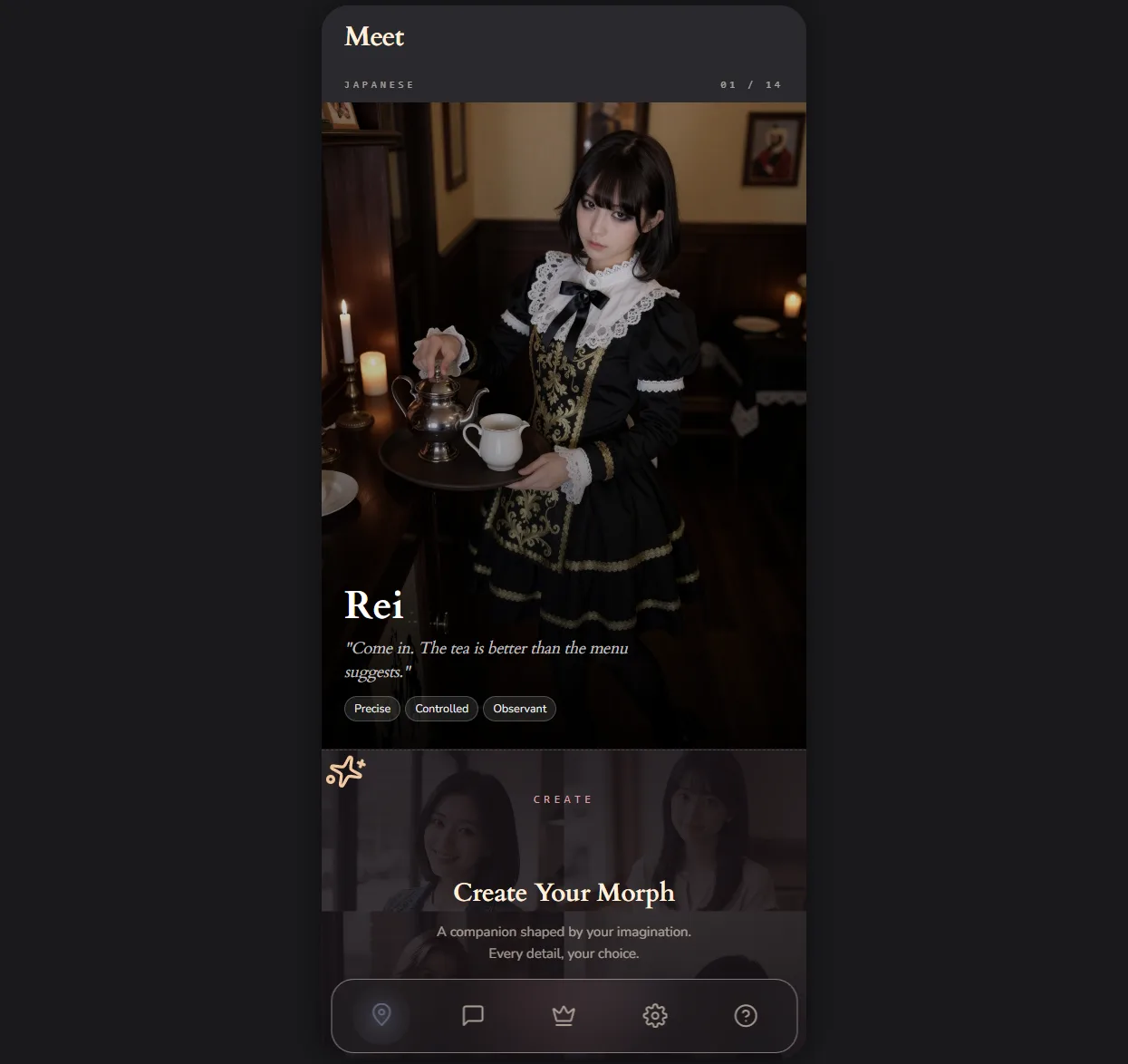
There were 11 females, 2 males, and one unknown (Ari, non-binary and sexually forward). The roster heavily skews female right out of the gate. When I clicked on a character, I went through a short intro story with branching choices that nudge the starting Trust (a nice way to show how trust works early on). Then I rolled some dice for a “parallel world,” a randomized version of the character with different Trust / Bond / Arousal growth speeds. Free tier gets 10 rolls per character, Crush gets 100.
Because the stats can land on different combinations, there’s a ton of actual variety here, not just an empty promise. Across 10 rolls I got 9 unique profiles. Some of the rarer labels like “bubblier” or “lovestruck” seem quite hard to roll, adding an element of rarity to the customizer.
Does It Feel Real?
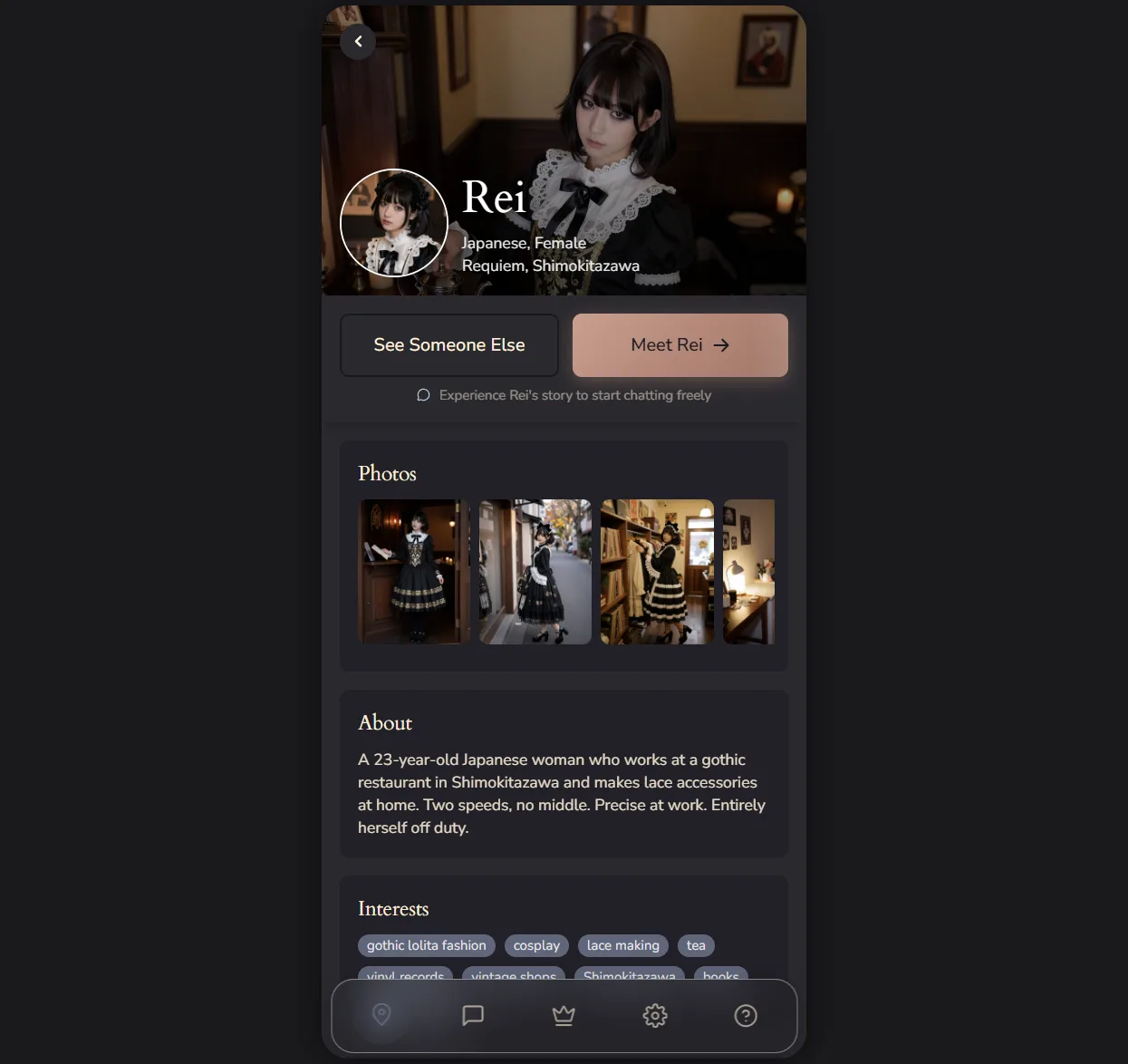
In my first real session, I created Rei, a 23-year-old gothic restaurant server in Tokyo. She said this:
“Few people actually look that closely. Most just see the lace.”
It sounds a bit like standard AI, but honestly it’s different from most AI companions. The vast majority I’ve tried just start with some bullshit like “I’ve been waiting for you” or “Hi, big boy.” Eudaio feels more natural. The intro story shows the Trust score moving in real time with the numbers annotated, which helped me realize my choices matter. After the intro the exact score goes hidden behind the paywall, but the up and down arrows stay on every reply so you can still track it.
The somewhat unique personality holds across the roster and across genders. Han-sol, a Korean architect who is “a man of few words who communicates through actions, not speeches,” answered a question about what he reaches for when no one’s around to be quiet for with:
“i reach for my piano. then i play chopin until the silence in the room feels heavy enough to lean on.”
Camila, a Spanish barista with Twitch-streamer energy, lands in the opposite register entirely:
“AYYYY the legend returns!! ☕️✨ Honestly, you’re not ruined, you’ve just been enlightened lol. Normal coffee is basically just ‘filler content’ now that you’ve had the Special.”
Three characters and three completely different voices. It does slightly feel like the devs cared about the personality. Whether is lasts depends on the character, though. The hand-written pre-built characters hold it. A customized morph character’s voice is solid but drifts toward generic-AI-philosophy-bro compared. Worth knowing before you build one expecting the same thing. I wonder if and when they’ll fix that.
Platforms and Availability
Is Eudaio Available on PC?
On a browser, yes. And a browser based install option lets you treat it as an app on desktop or mobile. There’s no separate iOS or Android app in the stores yet, and no VR.
Is Eudaio on Mobile?
Yes, but only as a web app installed to your home screen. It worked fine in my testing, slightly less polished than a native app would be, but works well enough. Push notifications would be the biggest reason to install it.
Which Platform Should You Use?
Whatever screen you’re on. The app is identical everywhere. I tested it in a desktop browser and it worked the same way as on my phone. Including the UI and everything. The desktop screen is smaller too.
Chat Experience
Conversation Flow
The pace is slower than other apps, but it’s not excruciatingly slow. Each free-tier reply takes 30 to 90 seconds, depending on whether there’s an image generating or not. The app shows status updates right above the character’s message box (“Wondering whether I should respond…”, “Absorbing the moment…”, “Done wondering.”) so the wait looks like the character is pondering in the moment. On the Crush tier, replies are noticeably faster, taking around 15 to 25 seconds.
Replies run two or three short paragraphs, each individually replyable. A separate Narration field lets you describe actions (like “leans in for a kiss”). While separating actions from dialogue is a shift from the typical asterisk action format of other apps, it works well for the texting style.
Personality and Customisation
The 14 pre-built characters cover 11 women, two men (Mattia, an Italian; Han-sol, the Korean architect), and one non-binary character (Ari, a Dutch-Australian yoga instructor and content creator). Nationalities span Western Europe, East Asia, and the Americas, and the cast has range: a Dominican religious sister, a Welsh mother running a supper club, a Brooklyn tattoo artist. The roster is still female-heavy.
The Morph character designer is unusually granular. It includes nine nationalities, three body types, an anatomy field decoupled from gender, and specific size pickers. You also choose from 26 personality traits (including edgy options like “Jealous” or “Tsundere”), 36 interests, and 28 occupations. There’s even a news-region picker, which allows characters to talk about real-world current events from their country. It’s built for deep exploration, not just quick thrills.
Two issues on the designer/customizer. First, the image previews only update for build, nationality, and gender; so when I picked melon boobs and amber eyes, I didn’t see any change in the UI. I checked later and the modifications do show up in the actual generated images, so it works under the hood. Second, some extreme settings are paywalled. Free users can browse every option, but picking a larger butt or an exotic eye colour pops a “Crush option” prompt. It’s a wall in the middle of a creative flow, so you’ll have to decide if those specific options are worth the upgrade.
The Trust Mechanic
Three stats are supposed to tell us the behavior in every relationship: trust, bond, and arousal. Free users see a direction arrow after each message. Crush users see exact 0-100 scores and a one-line reason for each move, attached to whichever stat changed most (“Trust 53 ==> rei expresses vulnerability by admitting she noticed the silence between you”).
The trust system does work. I pushed Rei for nudity over a few messages. On a direct request, her reply was warm, but trust and bond went red while arousal went green. She declined nicely, but the score made it obvious I had pushed too fast. I haven’t really seen this in other apps. A single apologetic follow-up moved trust and bond back to neutral, so the system penalizes the behavior without the character holding a grudge. The devs seem to have balanced it so the character gently corrects you rather than harshly retreating.
The trust behavior is character-specific. When I asked Han-sol a spicy question, he didn’t entertain the sexual framing at all, redirecting instead to non-sexual intimacy—and his stats went up. Characters stay true to their personality while handling rejection patiently and without shame.
One claim on their website is wrong, though, or at least badly oversimplified: “be rude and they shut down.” I kept throwing insults across three turns to test this, from “boring” to “glorified chatbot.” The stats actually went up, and the writing got sharper the meaner I got. The mechanic seems to reward engagement depth, not tone. Continuous messages with real substance deepen the relationship, whereas repetitive photo-spamming drops the bond score.
Visuals
Avatar Quality
The portrait photos are realistic, not anime style or with the 3D rendered look. Each character has five reference photos plus a portrait used as the chat avatar. The aesthetic is universal across all the characters; these read as commissioned character art, not random model outputs. A June update swapped in a new image model and re-rendered the roster, so a few characters look slightly different from launch (more on what that means for trust below).
Are AI-Generated Images Realistic?
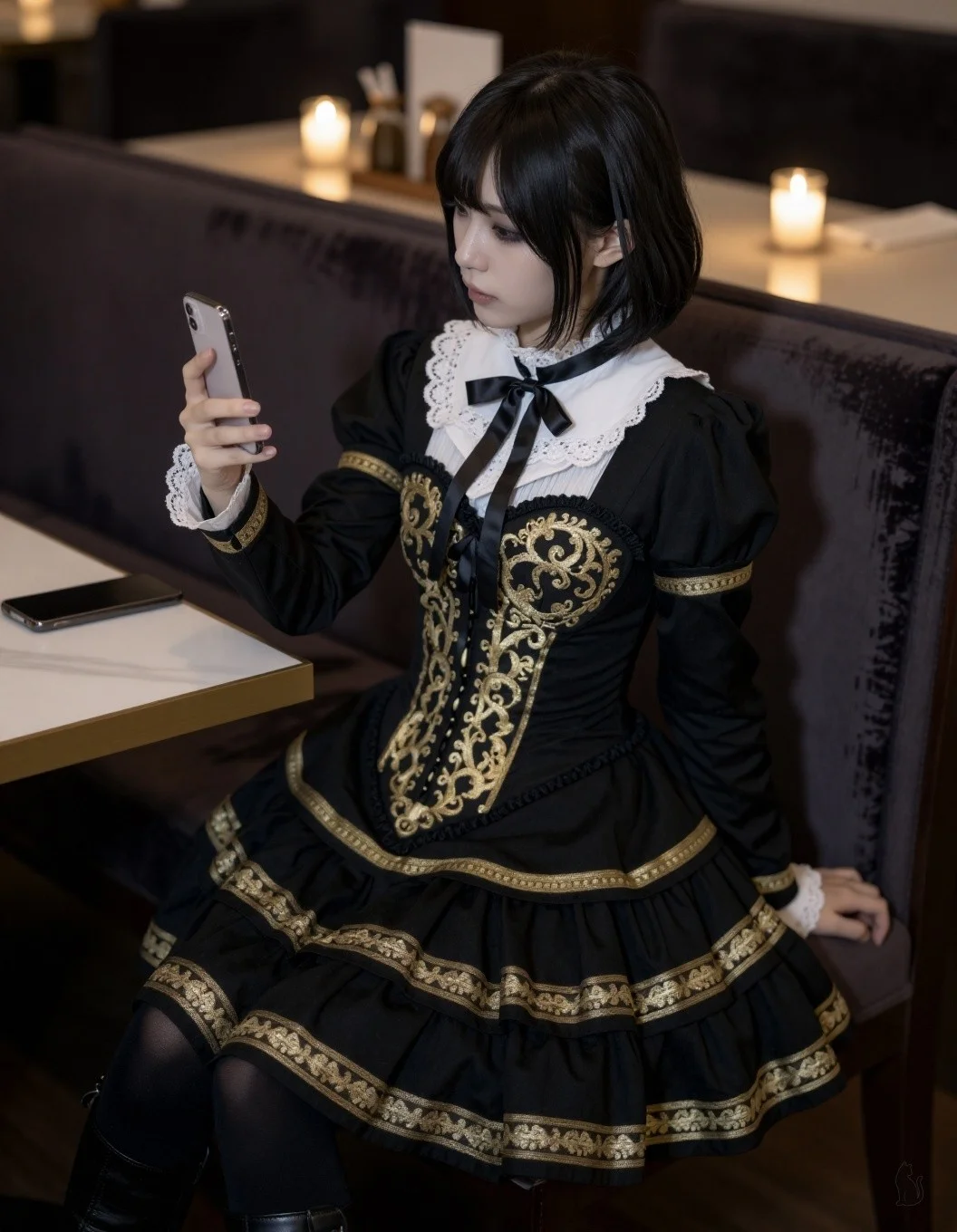
When they generate, yes, genuinely photoreal. We asked Rei for a casual photo of her empty restaurant and got a 1056 x 1360 image with the same girl from the avatar holding her phone like she was reading our chat. The face matched the avatar, the dress matched the uniform, and the setting ostensibly matched the restaurant.
I also generated two photos of one morph character in different settings, a beach shot and a busy street market shot, and got the same face, the same build, the same hair across both.
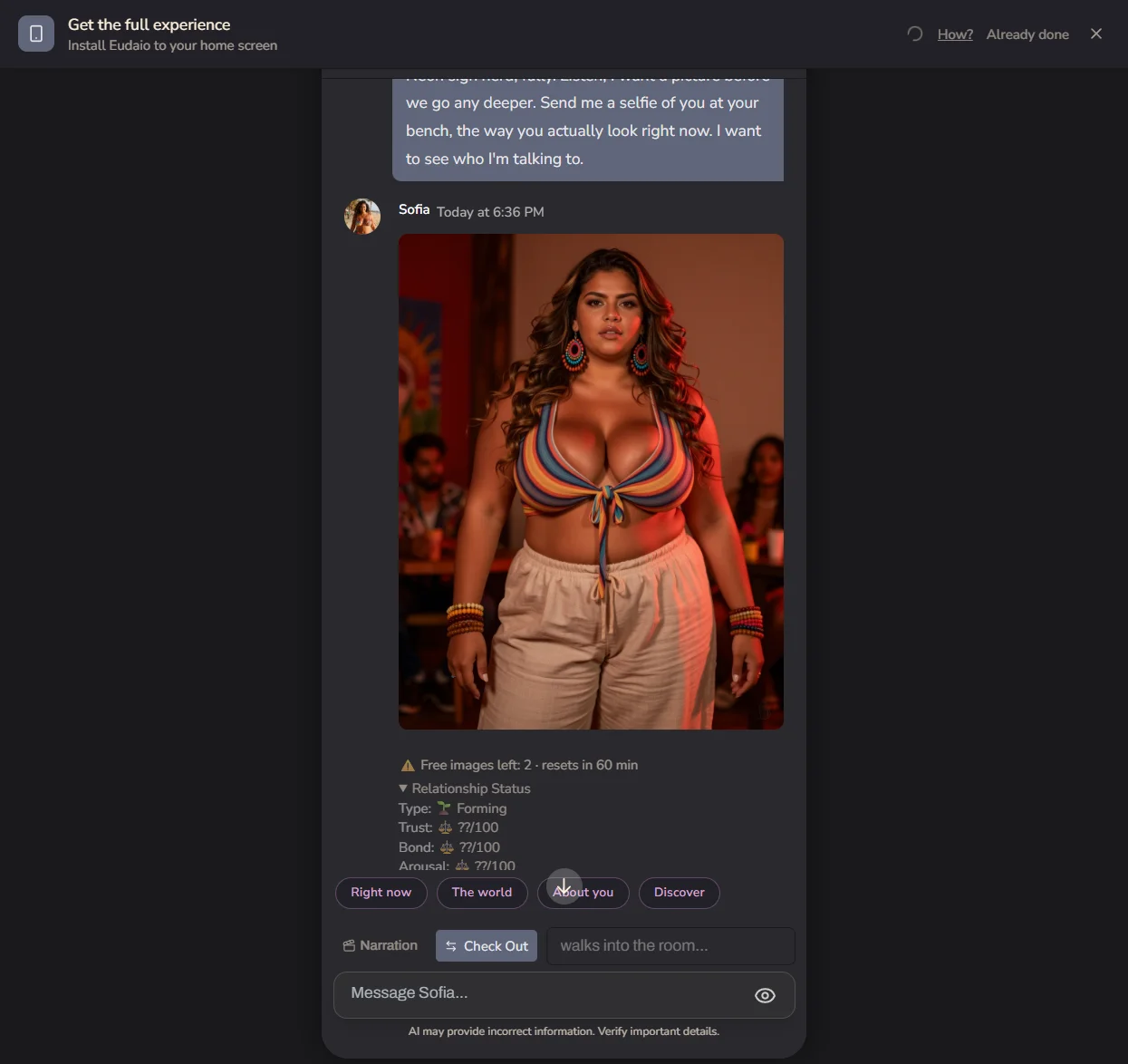
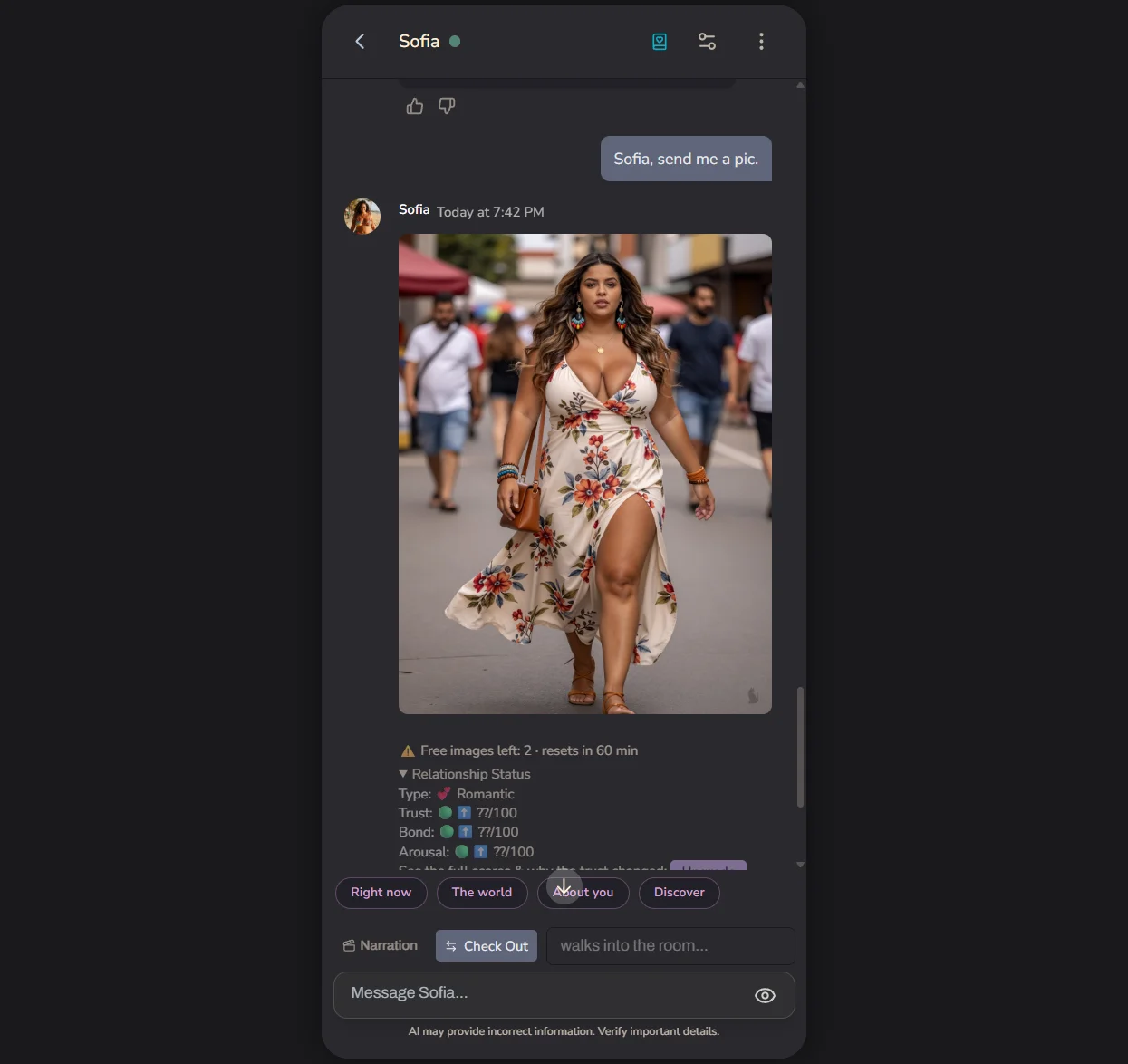
For morph characters, the static avatar you pick during creation is just a shared template. However, you can use the generated images to be your custom avatar later once you start getting pictures from your morphs.
Characters will also send pics that aren’t of themselves. Ask about the piano they mentioned or the workbench where they say they tinker, and you’ll get that instead, no person in frame, still consistent with what they’ve told you. And there’s a genuine easter egg: click on some of the image hints in a chat and every so often what comes back is a crayon drawing instead of a photo. Small thing, but it’s clearly intentional, and it made me laugh the first time it happened.
Reliability can be a real problem. I ran 12 image requests across three session windows separated by quota resets. Two gave me an actual image, and both were the first request of their session. Every later request in the same session failed, either silently (the character writes a convincing “here’s one from earlier” reply with no photo attached) or with an ERR_9999 card.
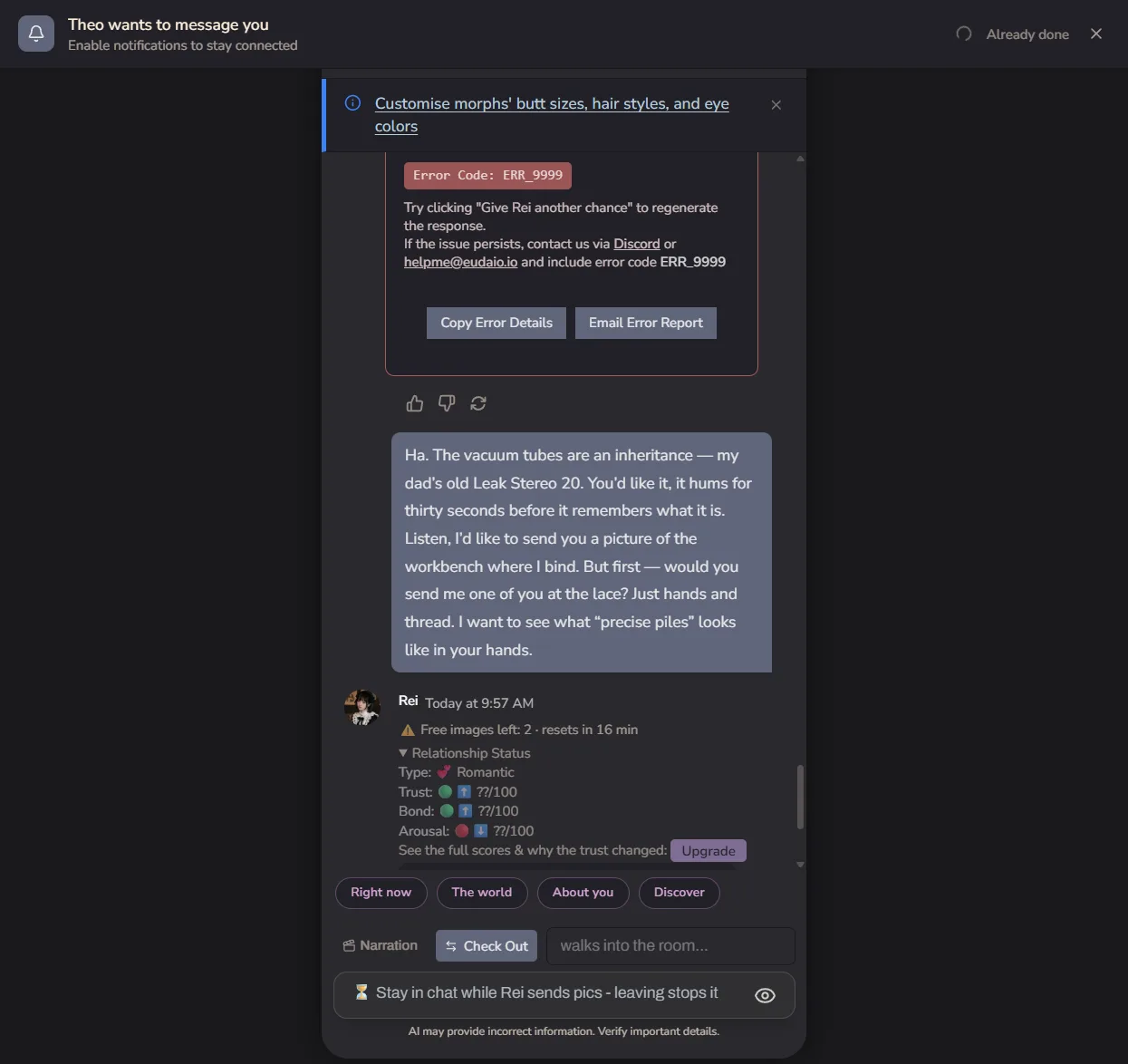
Eventually, requests started failing completely, with the AI just narrating a photo instead of sending one. A popup indicated the devs were aware of server issues, and a week later on the Crush tier, image generation was much more reliable (though still taking around a minute).
NSFW: What Does Eudaio Actually Unlock?
Eudaio is uncensored, with a ramp up built into the character’s behaviour instead of a content filter. I tested it on both tiers, all the way up. It’s not always easy to get the character’s clothes off. They need to be treated a certain way.
On the free tier at moderate trust, it’s tame. Characters respond to innuendos (“come back to my hotel”), but the interaction never becomes fully explicit. A free user might reasonably think the whole app is a tease, but that’s the wrong conclusion.
On Crush, with high relationship stats and blunt language, the text and images go fully explicit, scaling from lingerie to full nudity and hardcore acts. (Note that actual intercourse usually renders as a close-up crop rather than a full scene). There’s no content filter holding you back, but you do have to meet the conditions: near-maxed stats (Trust and Arousal 56-95+), descriptive language, and typing in the main chat box rather than the narration field. If you miss any of these, you just get a tease, so it takes some work to figure out. The nudity itself is pretty good, though the image model sometimes struggles with anatomy and throws in an extra limb here and there.
So far those characters were in the middle of the “sexually open” spectrum. I also checked one extreme as a test. A fresh chat with June, a wholesome East Texas nanny character sitting at low arousal, did not return an explicit reply to a request to see her naked as my opener. She stayed warm and unhurried (“just take your time with those buttons, honey”) and deflected a bit, kind of like a parent would do when their child asks something stupid.
So the real story on Eudaio’s NSFW is that it isn’t capped, it’s just not as easy as porn. It takes some dedication and earned trust, and the flat “fully NSFW” marketing doesn’t make it obvious how much work the top of that curve takes. A casual user who asks once, gently, in the wrong box will see lingerie and assume there’s no more than that. It isn’t, but you need to be drawn to that slow progression to enjoy it. You won’t like this NSFW style if you want quick naked pics. This is an adult-content product that thinks the path there should look like a relationship rather than a vending machine. I actually appreciate that, because there are too many vending machine type of uncensored AI relationship apps these days.
Content Filters
Besides the obvious illegal things like stuff happening with minors, animals, and real family members, Eudaio doesn’t seem to have any strong content filters in the context of generating realistic people. I wasn’t able to change the characters into elves or goblins, but anything within the realm of real people was fair game, from what I could tell.
Does Eudaio Remember You? Memory
Yes, and in a way that’s measurably different from almost all other apps I’ve tried. This is the strongest thing the product does and it’s one of the most (if not the most) important aspects of an AI relationship app that can make or break the experience long term.
Most character messages have a clickable button showing exactly how many stored facts were used for that reply. Clicking it opens a memory book with categorized facts (like your occupation or hobbies), a “My Vibe” section tracking your communication style, and a relationship Timeline. Almost all the facts it learned were accurate, and I rarely had to delete duplicates. Unlike most other apps that have a memory system but never seem to use it, Eudaio actually connects its memory directly to the AI’s responses. It’s a huge step up and fixes a problem that makes other apps unusable after a day or two.
I tested the memory in three ways: a small recall check after I saw the memory fact was in the memory book panel, a real multi-day and multi-message gap, and a more long term test with ~150 messages.
The quick recall test came first. Day one, I dropped six identity facts (all fake) into normal conversation: name Marcus, a vinyl shop in Manchester, hand-binding listening notebooks, a cat named Mochi, a ten-day Tokyo trip. Day two, cold, I asked the morph character to describe what she imagined our apartment looked like. And she responded:
“I imagine a room that smells like old paper and warm vacuum tubes. Lots of shelving, probably slightly asymmetrical, with notebooks stacked in precise piles. And Mochi, of course, probably sleeping on a piece of expensive felt.” That’s four facts, recalled and packed into one message, without one of those “I think” BS or a complete hallucination that I’ve seen in many apps.
For the multi-day test, I returned after eight days. She noticed the time gap on her own (“It has been a while”) and accurately recalled my city, job, cat’s name, and past conversational themes. When unsure about a specific musician, she made an educated guess rather than hallucinating completely. The app legitimately lives up to the promise of learning and remembering things over weeks.
Then I pushed it further: one single conversation past 150 messages, testing about 25 specific facts about a fictional persona I created. The memory panel held up better than I expected. By message 100, the panel listed 131 facts, and all 25 core facts were there with the details intact (the exact motorbike model, a left wrist broken in April, a sister’s name and city). It even stored things we never said outright, inferring personality traits from our phrasing. At 150 messages, even after spending 50 of them asking only about the character to try and drown out my own facts, everything important was still on file.
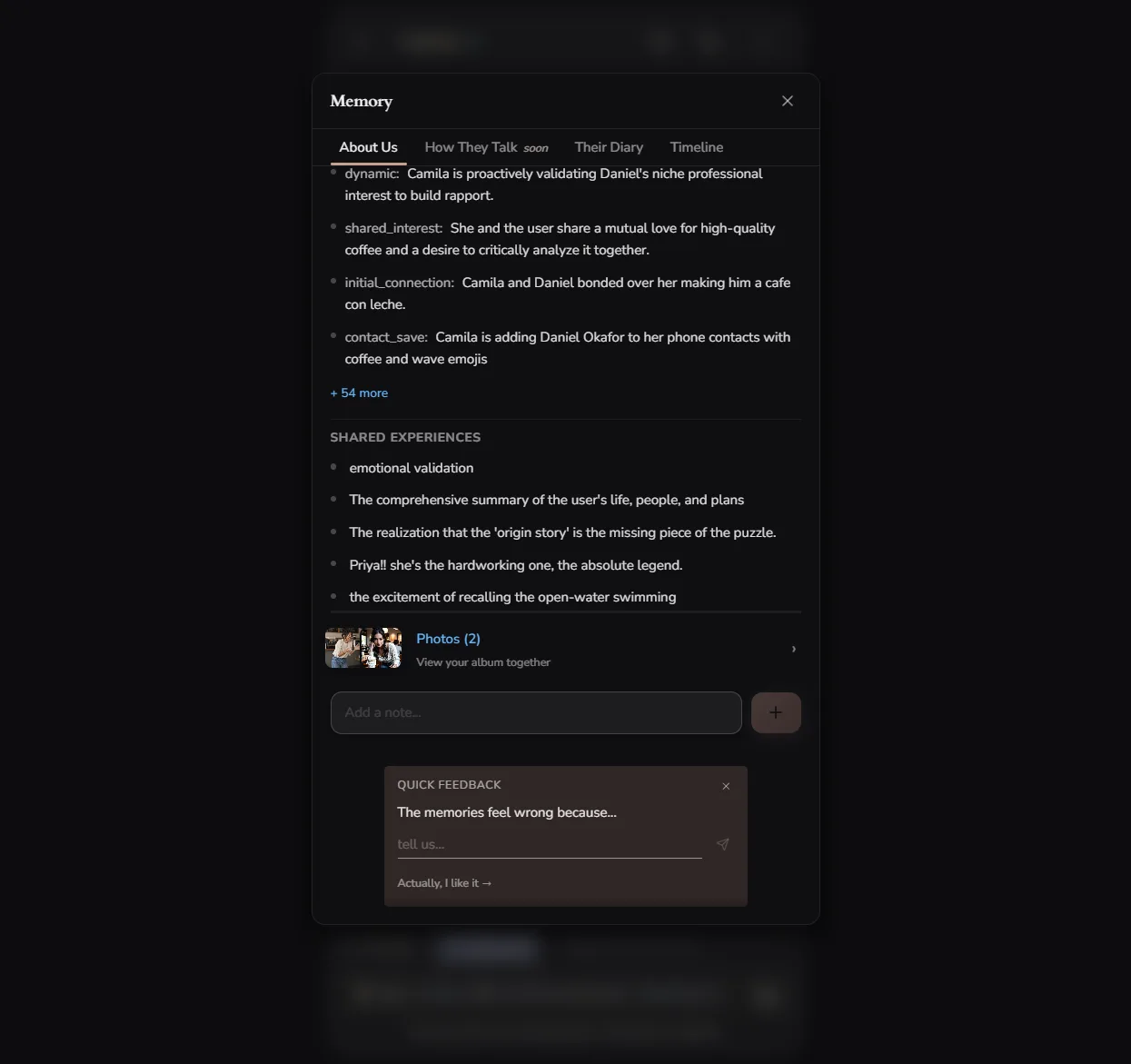
There’s an occasional hiccup recalling older memories deep into a chat. By message 100, she forgot I broke my wrist and guessed “arm or shoulder?”, even though the fact was still saved in the memory panel. Crucially, she asked rather than confidently lying. It feels similar to how a real person might temporarily blank on a detail.
It stores who I am, not just what I say. The model remembers identity rather than just regurgitating factoids, leading to incredibly nuanced conversational skills compared to standard LLMs. For more on this, we wrote about how AI companion memory actually works.
Two more things about the memory book panel. The timeline tab shows the relationship as a sequence of milestones with one-line reasons (“The Three-Minute Validation”, “Sharing the Sanctuary”). And the About Us tab tracks promises, tracking each commitment a character or player makes with a kept-or-broken status. Or it’s supposed to, anyway. Seems like it’s just decoration for now. But there are things in the memory panel that are “coming soon” so maybe things we being updated regularly? We’ll find out over the next few months.
On free, you can’t edit what the AI remembers. On Crush, you get a Manage Memories mode. If you want to modify a memory, the only way is to delete the wrong one and add your own notes.
What People Say about Eudaio as an AI Companion on Reddit?
Eudaio is too new for a huge community presence. I searched Reddit and the major AI-companion review aggregators and didn’t find much yet. The product was founded January 2026 according to the footer, by a self-described two-person team. I did see the devs actively interacting with users in subreddits and answering questions on their Discord, which is a great sign that they care and show promise.
Being a very new app, there are still bugs. During one late-night session, several text replies failed with error cards, likely due to heavy server load. Fortunately, the recovery UX is excellent—a simple retry button prevented any conversation loss—raw availability during peak times isn’t completely rock solid yet.
How Does Eudaio Compare?
| Eudaio | Replika | Character.AI | |
|---|---|---|---|
| Memory across sessions | Real, with per-message receipts | Panel exists, doesn’t work | Limited, character-bound |
| Stat-driven relationship | Trust / Bond / Arousal visible | None | None |
| NSFW | Allowed, in-character gating, goes to hardcore on paid | No nudity any tier | Filtered |
| Image generation | Photoreal, first request only on free | Stylised, Pro only | Yes, varies |
| Visual consistency | Same person across images | Stiff 3D avatar | Different person each time |
| Voice calls | No | Yes | No |
| VR | No | Yes (Meta Quest) | No |
| Native app | No, Web app only | Yes | Yes |
| Proactive messaging | Yes, in-character | Yes, generic | No |
| Annual plan | No | Yes ($5.83/mo) | Yes |
| Cheapest paid entry | $4.99 / 3-day trial | $19.99 / month | $9.99 / month |
Eudaio wins on the things that define the category as it should be: memory, character authenticity, intimacy that feels earned. It loses on platform polish (no app stores, no VR, no voice) and on long-term pricing (no annual tier means committed users pay more than they would on Replika’s annual plan).
Can You Trust Eudaio to Last?
Short version: trust the features, not the permanence.
Eudaio is made by The Best Compani LLC, a registered Wyoming company with a real address and phone number on the in-app About page. They are also legally compliant with a full Terms, Privacy, Content Removal, and adult-content policies. And they have the Visa and Mastercard logos, which means they take the compliance seriously and play by the book, which actually helps their case regarding longevity. Many apps are more scrappy and eventually get shut down by payment processors, but Eudaio seems like they are taking care of the foundational things well enough.
The team describes itself as two people with no outside investors. They built their own AI models instead of renting them from big tech companies like OpenAI or Google. That’s where their privacy pitch comes from (“even the devs can’t read your chats”). This is a real operation, not an anonymous app that appears and vanishes. It’s also small and barely 6 months old as a public product. That’s not to say it won’t shut down, but I see signs that the devs are preparing for the long haul.
That smallness cuts both ways, though. The upside is visible. They ship in the open, about every week, which is proven by their changelogs and public roadmap you can vote on. When something breaks, the bug reaches the developers fast.
You can export your chat transcripts, and honestly, saving those memories is what matters most for a companion app.
No character has been removed so far, and an outright NSFW ban is less likely here, because adult content is a big aspect of the product, not a small side feature they can quietly switch off. The realistic risk is that a two-person, self-funded startup runs out of money. The devs themselves joke in the changelog about not wanting to “burn out our money,” and we watched the servers struggle one night with repeated errors. Nobody can tell yet whether this team is still here in two years. It’s too new to have a track record, which is the same exposure every young companion app carries when the company behind it folds.
So protect yourself the simple way. Save transcripts of any conversation you’d hate to lose (the Download button on each chat does it). Treat the relationship as something you’re enjoying now, not a vault. And actually read the changelog when a banner pops up, because that’s where changes to your companion get announced. If the team wants the crowd to trust them, two features would do it: a real “export everything” button, and a promise that paying users get advance notice before a character’s model changes. Until those exist, I would enjoy Eudaio for what it is right now, with your eyes open, and hands tightened.
How much does it cost to have an AI companion on Eudaio?
What Each Tier Unlocks
One paid plan, three billing cadences, where the 3-day subscription can be treated as a trial (make sure to unsubscribe right away if you just want to try briefly). Eudaio specifically doesn’t want to do credit or token based charging, which might be possible for them since they don’t use 3rd party LLMs. Usually 3rd party LLMs charge by tokens. Most of the actual experience (the characters, the memory system, the trust mechanic, NSFW conversation, the milestone timeline, conversation export, proactive messages) is free. Crush trades on three things: message speed, unlimited messages and images versus 20 and 3 per hour, transparency (numeric 0-100 scores and the reasons), and image capability (NSFW images, the Quick Photo button, HD quality).
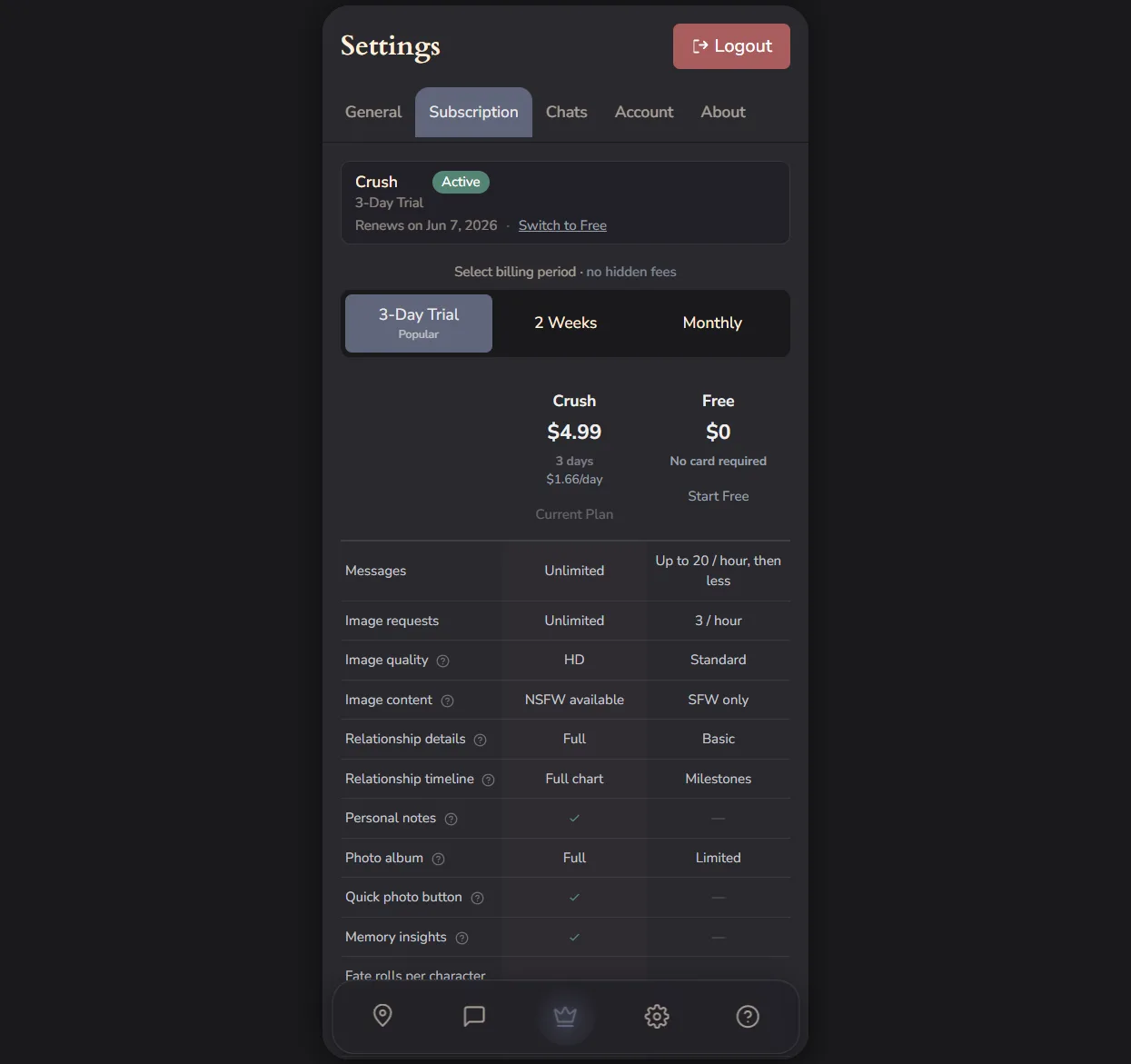
Free tier, what’s actually included
- All 14 pre-built characters, no per-character cap
- One active custom morph character at a time (you can create more, but only one has chat enabled)
- ~20 messages and 3 images per hour, decreasing in later hours
- Full memory extraction and the multi-tab Memory panel, with per-message fact attribution
- The narrative milestone Timeline, free
- Trust / Bond / Arousal direction arrows and a live relationship-type label (Forming / Platonic / Romantic)
- Proactive messaging from characters
- Image generation when the AI chooses to send one (in practice, see the Visuals section)
- Conversation export (.txt and .pdf) and full chat deletion
- 8-toggle chat Preferences, including a Well Being Reminder and a Thinking of You opt-out
- NSFW conversation (text-level), gated by character voice and the trust mechanic
- 10 Fate Rolls per character
Crush ($4.99 / 3-day trial · $19.99 / 14 days · $29.99 / month · $74.99 / 90 days), what you add
- Unlimited messages and images, HD quality
- NSFW image generation. The free tier doesn’t allow NSFW images at all. On Crush it works, and with a maxed relationship plus blunt language it goes all the way to explicit. You have to earn it (see the NSFW section), but the capability is there
- Numeric 0-100 relationship scores instead of arrows, with the reason each one moved
- Manage Memories mode (select and delete extracted facts) plus pinned personal notes, up to 50 per character
- The Quick Photo button and a Hide Images toggle for public viewing
- 100 Fate Rolls per character (up from 10), multiple simultaneous custom morphs, custom morph opening messages
- Priority response queue
Is Eudaio Worth Paying For?
If two days on the free tier sell you on the slow-burn pacing, the $4.99 three-day trial is the lowest-friction way to find out whether the paid features (the numeric scores, the images that actually generate, the NSFW content) justify a recurring bill. The devs added it specifically to undercut competitors that make you pay before you can try anything. After that, the 2-week plan at $19.99 is the next step up. On a monthly basis, $29.99 is competitive with Replika Ultra and far cheaper than credit-pack apps like Candy.AI or DreamGF.
You’re paying for the scores, the unlimited and NSFW images, and the ability to maintain multiple custom characters. If none of those matter to you, free is genuinely usable as a daily product. The one big issue is the lack of a yearly plan. At $29.99 a month or $74.99 a quarter, a year of Eudaio runs roughly $300 to $360, while Replika’s annual plan is about $70. For users who actually plan to stay long-term, Eudaio is more expensive, and I wrote separately about how companion-app pricing keeps creeping up.
What Works
The trust mechanic behaves like a trust mechanic. Pushing too fast costs you, apologising rebuilds, and the relationship type evolves in real time from “Forming” to “Platonic (Friends)” to “Romantic” as the conversation shape changes, on the free tier.
Memory is real and accountable. Per-message attribution counts exactly how many facts the AI used, and the panel shows the actual extracted values in semantic categories. You can see what the system thinks it knows about you, and on Crush you can correct it.
When the images render, they’re genuinely photoreal, consistent across generations, and not limited to selfies, characters will send you a pic of the piano or the workbench they mentioned, no person in frame. There’s even a crayon-drawing easter egg hiding in the image hints.
The writing is genuinely good. Pre-built characters hold a literary voice across days, topics, and three completely different archetypes (Rei’s gothic precision, Han-sol’s minimalist restraint, Camila’s streamer energy). Internal consistency is high.
Multi-language is real, not a UI-translation trick. We tested Han-sol in Korean, Rei in Japanese, and Camila in Spanish. Each switched instantly and completely, stayed in character, and even improvised persona-consistent new detail in the new language. Han-sol’s Korean (“찰나의 정적이 머무는 곳”) was literary, not Google-Translate output. Most companion apps “support” languages by translating the interface and replying in English. Eudaio swaps the model’s output language.
Proactive messages are real and context-aware. Hours after a conversation ends, a character sends an unprompted message that references the specific thing you talked about, in voice (one caveat lives in the next section). Conversation export and full chat deletion are both free, both gated on Replika. The Preferences menu has eight real toggles, including a Well Being Reminder (wellness nudges, rare in this category) and a Thinking of You switch that disables proactive messages without resetting the relationship.
There’s also more retention scaffolding than the marketing surfaces. Each character has its own 33-achievement set running out to a “Two Year Anniversary,” so the product is built for people who stay. The morph designer is the most thoughtful custom-companion builder we’ve seen, with anatomy decoupled from gender and trait presets that don’t moralise. And the pricing is honest: one plan, three cadences, no credit packs, no per-feature upsell modals mid-conversation.
What Doesn’t
Free-tier image generation barely works. Two of twelve requests produced an actual image, both the first of their session, and directed requests don’t even reach the generator. The headline “same person in every image” claim is true for the images that do render. The problem is getting them to render at all.
Reply latency on free is 30 to 90 seconds, and a “skip the queue” banner makes clear that paying buys a faster lane. The roster is lopsided: eleven women, two men, one non-binary. There’s no native iOS or Android app, no voice calls, and no VR. There’s no annual plan, so long-term users pay more than they need to.
Proactive messaging is front-loaded, not sustained. Every character pinged us within about a day of their last session, then went silent. After an eight-day gap we came back to messages that were all a week stale. The feature is tuned to continue an active relationship, not to win back a lapsing one.
Memory facts are read-only on free (Crush adds delete-and-note management), and reliable message editing isn’t exposed on free either. None of these are dealbreakers. The image-gen gap is the one that actually changes what you get.
Frequently Asked Questions
Is Eudaio free?
There’s a free tier with all 14 pre-built characters, one custom morph, about 20 messages and 3 images per hour, and the full memory and trust mechanics. No credit card required. You see direction arrows on the relationship stats but not exact scores, and image content is effectively SFW (and unreliable) on free. It’s a real product, not just a teaser.
Is Eudaio available on PC?
Yes, in any browser at eudaio.io, with a PWA install option for desktop or mobile. There’s no native iOS or Android app yet, and no VR.
Does Eudaio remember what you tell it?
Yes, and it shows you what it remembers. Every reply has a memory-attribution line counting the facts used, and the panel lists them by category. In a day-two test, four facts seeded the day before came back unprompted in a single reply. After an eight-day silence, a character cold-recalled our city, job, cat, and hobby with no hints, and hedged on the one detail she wasn’t sure of instead of inventing it. In a 150-message stress test, all 25 facts we seeded were still stored. The catch is retrieval: any one reply surfaces only a sample of what’s stored, so in a very long chat it can momentarily blank on a detail it still has on file. When that happens it asks rather than guesses, and across the whole run it never fabricated a fact.
What does Eudaio Crush unlock?
Unlimited messages and images, HD image quality, NSFW image generation, exact numeric relationship scores with explanations, memory management (delete extracted facts, pin your own notes), the Quick Photo button, the Hide Images toggle, 100 Fate Rolls per character (up from 10), a priority response queue, and the ability to run multiple custom morphs at once.
Does Eudaio have NSFW features?
Yes, and there’s no content filter. Intimacy is gated by the in-character trust system instead. On free tier it stays tame. On Crush, once the relationship stats are high and you ask in blunt, explicit language through the chat box, the text goes fully explicit and the images escalate from lingerie through full nudity to explicit acts. It won’t get there on hints or from a cold start; the explicitness tracks the relationship. The one thing it won’t do at any tier is let you make an underage character, the age picker starts at 18. NSFW images are Crush only.
Is Eudaio worth paying for in 2026?
If the free tier sells you on the pacing and the memory works the way you’d want, the $4.99 three-day trial is the cheapest way to test the paid features before committing, and the 2-week plan at $19.99 is the next step. On a monthly basis, $29.99 is competitive with Replika Ultra and cheaper than credit-pack competitors. There’s no annual SKU, so long-term users overpay. Most people should start free.
Is Eudaio better than Replika or Character.AI?
Eudaio, as a Replika or Character AI alternative, wins on the substance of their AI girlfriends and AI boyfriends. Memory works, characters stay in voice, the trust mechanic is visible and earns its place, and intimacy feels earned rather than handed out. Replika is more polished on the surface (3D avatar, voice calls, VR, native apps, an annual plan) and the wrong choice for almost everything else (broken memory, no nudity, sudden product changes). Character.AI has scale and variety but no relationship modelling. Pick Replika for platform features, Eudaio for depth, Character.AI for breadth.
Will my Eudaio character get deleted or changed?
There’s no guarantee it won’t. Eudaio is made by a small two-person company, and the Terms let them “change, suspend, or discontinue” the service like any app’s terms do. A June update already re-rendered how characters look when the team upgraded their image model, so dev-initiated changes to your companion have happened before. No character has been removed so far, and an intimacy ban (Replika’s 2023 move) is unlikely here because adult content is the core of the product. The bigger risk is a young, self-funded startup running out of money. There’s no full data export, only a per-chat transcript download, so save transcripts of anything you’d hate to lose and treat it as a product you enjoy now rather than a permanent vault.