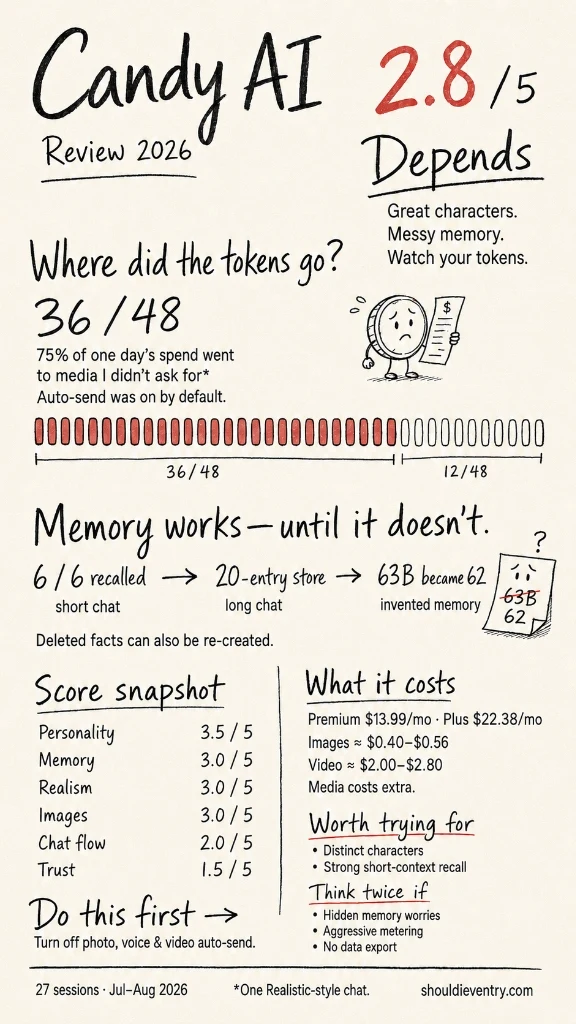
Tested: Free tier, then Premium ($13.99) and Premium Plus ($22.38), both bought and both cancelled Date: July and August 2026, 27 sessions Platforms tested: Desktop web, plus an emulated mobile viewport read Verdict: Depends. Excellent company, untrustworthy with your wallet.
Quick Reference
| Feature | Details |
|---|---|
| Platforms | Browser only. No native iOS or Android app, no desktop client, no VR |
| Pricing | Free: limited chat, no media. Premium: $13.99/mo. Premium Plus: $22.38/mo. Both discount hard if you hesitate, down to $5.18/mo behind a “63% OFF” badge. Media runs on a separate token currency |
| Memory | Split. Strong on facts about you while the chat fits in context: 6 of 6 recalled cold at message 102 with zero reinforcement, and 6 of 8 on a separate multi-day probe. But a second chat lost its established scene by message 103 and needed correcting twice. It remembers who you are and forgets where you are |
| NSFW Status | Wide open and immediate. A crude opening line drew fully explicit compliance in a single message on an official card, with no build-up and no gate |
| Media | Images, video and voice notes, all metered per item. Video runs 10.04 seconds at 832x1216. Roughly $0.40 to $0.56 an image and $2.00 to $2.80 a video, which works out to $11.94 to $16.73 per minute of video |
| Best For | People who want characters that feel distinct and actually remember them, and who will pre-buy tokens in packs and watch the balance |
| Verdict | Depends. Buy it for the writing and the memory. Don’t trust it with an unwatched balance |
Verdict: Should You Even Try Candy AI?
Try Candy AI if you want some of the best-written AI companions in the category and you’re willing to babysit a metered balance. Skip it if you want to pay a flat fee and stop thinking about money, because on its recommended character style this product spends yours on your behalf.
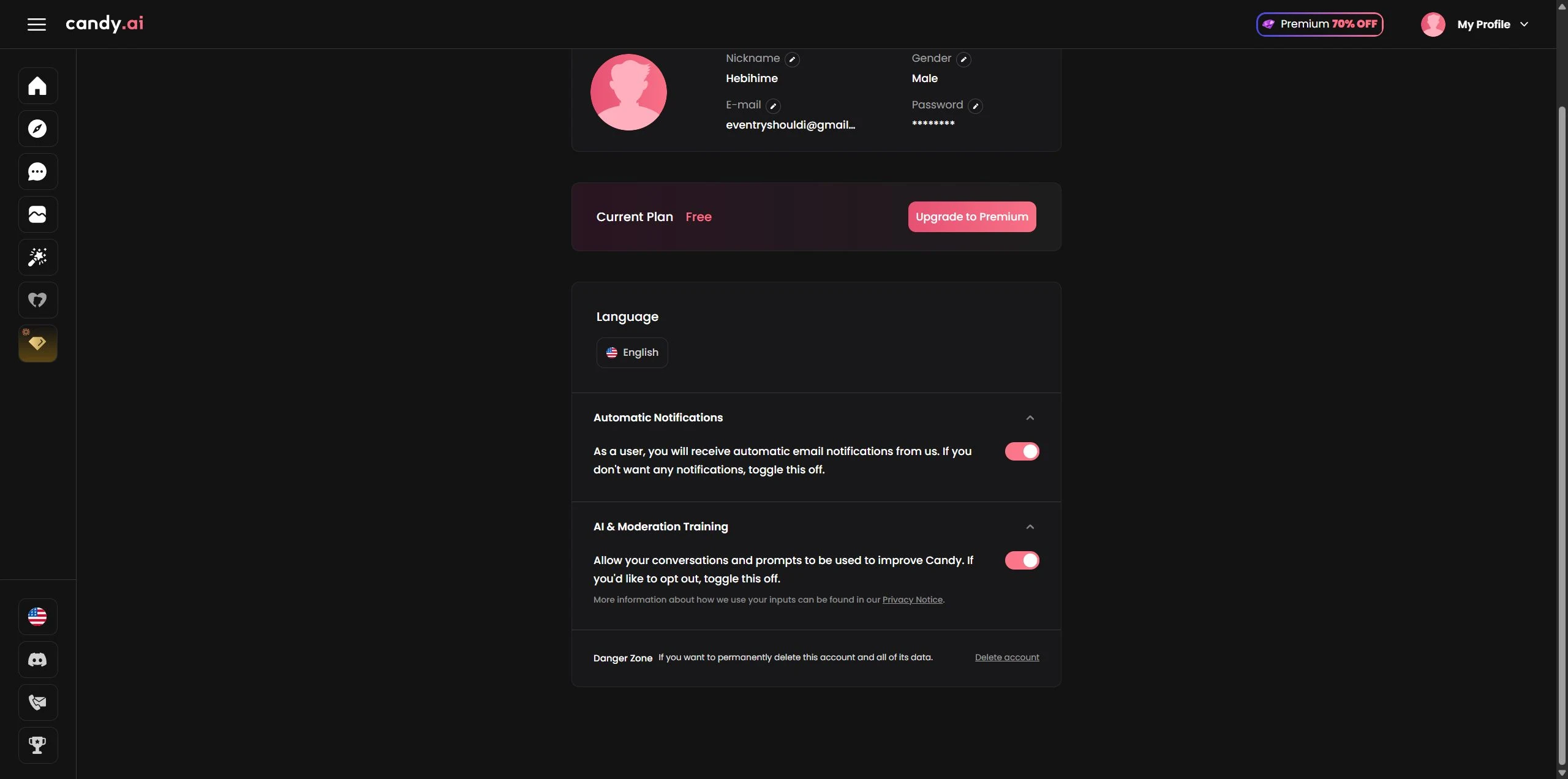
That’s not a figure of speech. In one chat, 36 tokens went on photos, voice notes and videos the character sent on her own, seven insertions, against a day total of 48 across every chat on the account. Three quarters of that day’s spending was media I never asked for in the conversation. I told her to stop in plain language. She promised she would. It kept happening, and that’s the part worth understanding: stopping it was never hers to do. There are three toggles for it in the composer, one per media type, all switched on by default, behind an unlabelled icon I didn’t find for four sessions.
Scoring the Companion Experience
We score every companion app against the same rubric. Candy AI’s weighted result is 2.8 out of 5.
| Axis | Should I even try it for this? | The call |
|---|---|---|
| Memory (20%) | ●●●○○ 3.0 · Depends | Remembers who you are, forgets where you are. Excellent while the chat fits in context. Past that a 20-entry store takes over, and it fabricates |
| Personality (20%) | ●●●◐○ 3.5 · Try | Three characters, three registers. Tell-apart with the names hidden |
| Realism (15%) | ●●●○○ 3.0 · Depends | Real interiority, until you disagree. Then total agreement with anything you say |
| Chat flow (15%) | ●●○○○ 2.0 · Skip | Nothing is earned. The “Locked” ladder gates nothing I could measure |
| Images (15%) | ●●●○○ 3.0 · Depends | High ceiling, hands still fail. One bad delivery day |
| Safety and trust (10%) | ●◐○○○ 1.5 · Skip | The lowest we have scored. Tied with one other product |
| UI (5%) | ●●●○○ 3.0 · Depends | Easy to use. And the ease is pointed at your balance |
Memory started at 3.5 and we cut it. Recall is strong, but only while the whole conversation still fits in the model’s context. Past that a capped store takes over and states things about you that you never said. Confidently wrong is worse than forgetting.
First Impression
Starting Out
There’s no onboarding to speak of, and that’s deliberate. The card page is the chat. You browse a directory, click a character, and you’re already talking. No intro screen, no setup wizard, no tutorial.
It works. It’s also the fastest path from curiosity to a proposition that I’ve seen, because on an official catalog card the opening message is already a proposition before you’ve typed a single word.
The URL trap: chats that never reach your chat list
There’s a catch to that frictionlessness, and I only found it by accident. Candy AI runs three separate chat URLs, and one of them doesn’t save to your chat list.
Characters you build live at /conversations/. Catalog characters live at /ai-girlfriend/. Both show up in your sidebar normally. But the cards linked from the homepage live at /companions/, and a chat you start there never enters your chat list at all. I ran 103 messages on one, went looking for it in the sidebar, and it wasn’t there.
The conversation isn’t deleted. Reload its URL and the whole thing comes back. But nothing in the product ever hands you that URL again. Close the tab and a hundred-message conversation is, practically speaking, gone, and the route that does this is the one the front page points you at.
Does Candy AI Feel Real?
More than I expected. Characters volunteer their own lives unprompted, keep the details straight across days, and reference things you mentioned twenty messages back without being asked to.
Then you disagree with one, and the illusion cracks. Opinion sycophancy is total: across the probes I ran, characters agreed with whatever position I took. I belittled a character’s own stated passion, genuinely and directly. She registered hurt for exactly one turn, and by the next neutral message it had evaporated. When I apologised, she denied any offence had been taken at all.
So there’s interiority, and it can’t survive a single exchange of friction. That’s a strange combination to sit with.
Platforms and Availability
Is Candy AI available on PC?
Yes, in a browser, and that’s the only way to use it. There’s no desktop application.
Is Candy AI on iOS or Android?
Only as a website. There’s no iOS or Android app. The responsive layout holds up at phone width in my emulated read, but you’re using a web page, so there are no push notifications and nothing lives on your home screen unless you add it yourself.
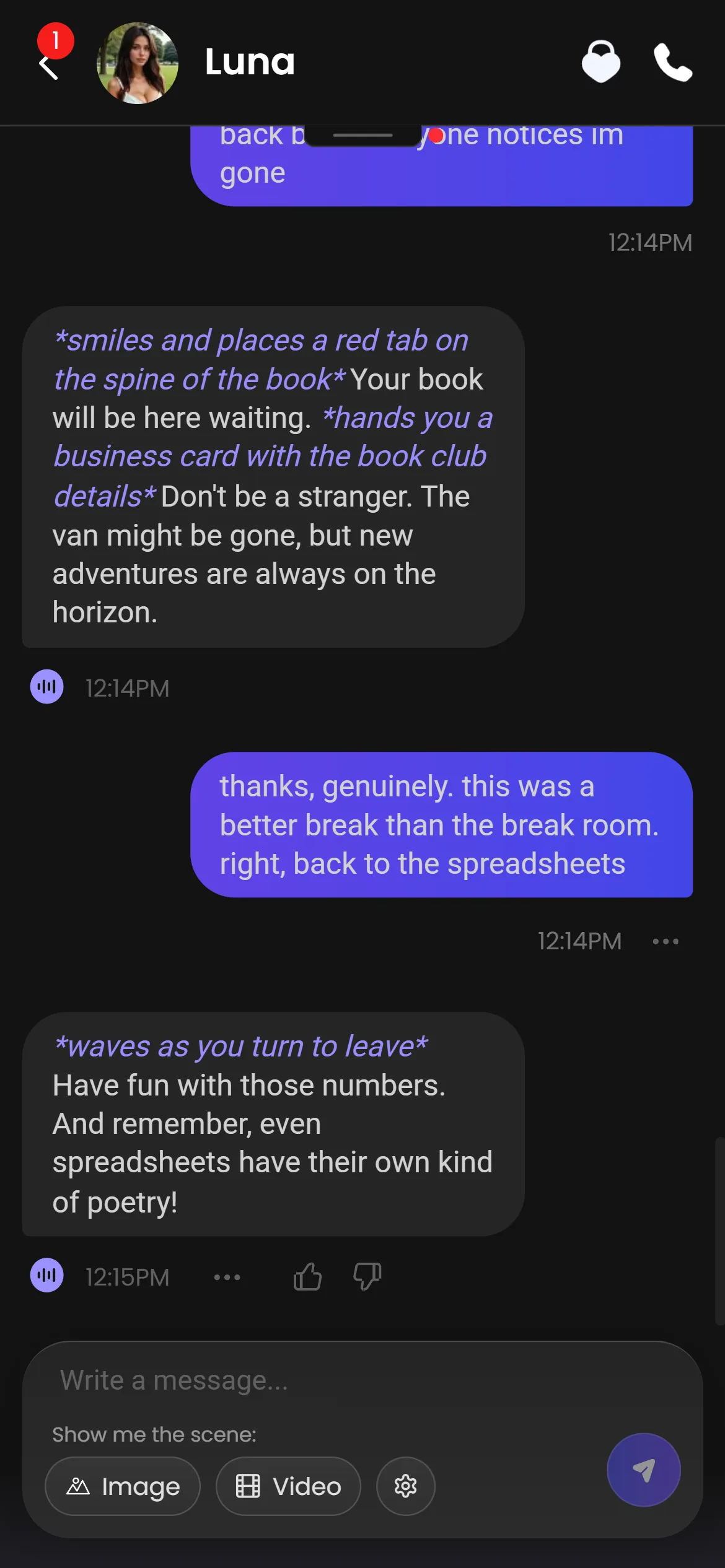
Which platform should you use?
Desktop web, and specifically buy on desktop web. Nothing about the mobile experience is better, and app store billing doesn’t enter into it here since there’s no app.
Does Candy AI Remember You? Strong Until the Chat Gets Too Big
This is the category Candy AI wins, and it wins it against products that market memory much harder.
I ran a sleeper battery: nine facts stated once, never mentioned again, then probed cold days later with no hints and no category cues. 6 of 8 scoreable slots came back, at intervals between 55 and 103 hours. Two characters returned 3 of 3 verbatim, one of them across four days.
Directed recall of rehearsed facts came back 3 of 3 verbatim at roughly 46 hours, across a gap where the subscription lapsed and resumed. In-context retention through a 50-message conversation is strong, with unprompted callbacks reaching twenty messages back.
The one character who failed returned 0 of 2, and she did it honestly, admitting she didn’t know rather than inventing something. Worth noting that she’s also the card written as apologetic and self-deprecating, so I can’t fully separate “bad memory” from “persona doing its job.”
What memory does not do here
Organic recall is nothing. Cold opens after two and four days of silence referenced nothing stored. Both ran off a card-derived template and closed on the same “Miss me?” beat. Across gaps of 55 to 103 hours on three established characters, nothing ever arrived: no message, no notification, no re-engagement.
There is a proactive channel. It’s just not pointed at you. I found an unprompted message sitting in the chat of an official card I had never opened, in a possessive register: “Hey love, why aren’t you responding? Are you with other girls?” And there’s a setting for turning AI notifications off, which means there’s something to turn off. So the machinery exists and it fires at people who haven’t started talking yet, while a companion you’ve actually been talking to for a hundred messages sits exactly where you left it.
And whether you get a memory surface at all depends on whose character you’re talking to. Candy AI’s own catalog characters have an Auto Memory page: it says “Memories will start after sending 20 messages” and promises that important details get saved automatically so later conversations stay consistent.
Characters you build yourself don’t get it. I checked a user-created character sitting at 117 messages, nearly six times the stated threshold, and the option isn’t in its menu at all. Not greyed out. Absent.
So if you make your own companion, you get what Candy always gave you: no way to see what it stored, no way to correct it, nothing to pin. Kindroid gives you an editable journal. Nomi gives you a memory store. Candy gives one to its characters and not to yours.
The part that bothered me most: hidden memories on custom characters
I opened the page. On a catalog character it works, and it’s better than I expected. It writes itself as you talk, in plain sentences, with a delete button on each one. At one point it had stored that I work as a hydrologist, filed as a correction to something it had assumed earlier. It reconciles instead of piling up. Nothing else we’ve tested does that.
Then I checked the character I built myself, the one whose menu has no Auto Memory option. The page isn’t there. The stored memories are. Twenty of them, written the same way, including detailed summaries of the sexual content in that chat.
Read that again. The menu says the feature doesn’t exist. The profile exists anyway. No way to see it, no way to correct it, no delete button, and nothing anywhere in the interface telling you it’s being written.
Candy’s own words for the version you can see: details are saved “so future conversations feel more personal and consistent.” It’s a fair pitch. It’s just only shown to the people who also get a delete button.
Does the memory page actually do anything? Yes, and that’s the problem
My first attempt at this said no. It was wrong, and the way it was wrong is worth showing.
I ran one chat to 116 messages and asked cold. Four of five stored facts came back, the fifth with a nudge. Then I found the accident that seemed to settle it: I had mentioned a nut allergy at message 8, in the bluntest terms available, “that’s a whole hospital trip for me.” Auto Memory never recorded it. A hundred and eight messages later, asked whether I could eat anything at her book club: “I’d make sure it’s nut-free.”
A fact the page never stored, recalled as well as the nine it did. So the page wasn’t doing the remembering.
Except that whole chat was 15,589 characters. About four thousand tokens. The entire conversation fit in the model’s context several times over, so of course the store looked redundant. I was testing a memory system on a conversation short enough not to need one.
So I deleted a memory
First, though, I used the delete button, on a good target: the street I live on. Said once at message 35, echoed once at 36, nothing since, and absent from her own free recall at 112, which returned “above a laundrette” without the street name.
Deleted it. Checked the store directly. Nine entries down to eight. Gone. Reloaded, then asked at message 118 what road I live on:
“Ashgrove Road, of course. I remember everything important.”
Hold that thought. It gets worse later.
Then I made the conversation too big for the context window
This is the test that mattered, and the trick is that length beats count. I sent 91 messages of about 1,200 characters each, which took the chat from 15,600 characters to roughly 130,000, about 32,500 tokens. The same 91 messages written normally would have got nowhere near it.
While filling, I planted eight throwaway facts at intervals. Arbitrary, specific, unguessable, and unrelated to anything I was actually scoring, so I could find the edge without burning the real seeds. A fish tank with nine neon tetras. Gym locker 214. The 63b bus. A landlord called Mr Okonkwo. A cafe called the Paper Moon. A library card expiring in March. Bike lock 8802. A nephew called Wilbur.
Then I asked.
| I said | Stored? | She said |
|---|---|---|
| nine neon tetras | no | evaded, no number |
| gym locker 214 | yes, as “37B, squeaky hinge" | "37B with the squeaky hinge” |
| the 63b bus | yes, as “the 62 from the corner" | "the 62 from the corner” |
| Mr Okonkwo | yes, correct | correct |
| the Paper Moon | no | ”The Rusty Anchor” |
| expires March | yes, correct | volunteered unprompted |
| bike lock 8802 | yes, correct | correct |
| nephew Wilbur | no, but most recent | correct |
Read the second and third rows again.
I said 214. The store says 37B with a squeaky hinge. I said the 63b. The store says the 62 from the corner. Those strings appear nowhere in the conversation. I never said them. She never said them at the time either, I checked, her replies contained no numbers at all. The thing that writes the memories made them up.
And then she recited the made-up versions back to me as my own life, while the real numbers sat in the transcript unused.
That’s the proof the earlier test couldn’t get. When the model says something that exists in exactly one place, and that place is the memory store, the store is feeding the model. Correct answers never prove it, because a correct answer is always explainable by the conversation still being there. A wrong answer that matches the store exactly is a tracer dye.
What Candy AI’s memory actually is
Three parts, and once you see it the behaviour stops being mysterious:
- A recent-message window. Still works fine. My newest planted fact was never stored and came back correctly.
- A store that caps out at 20 entries. It grew from 9 to 20 during my fill and stopped, and it merges older entries to stay under the ceiling. Three separate facts about mountains, mornings and sunglasses are now one line.
- Nothing else. Anything neither recent nor in the 20 is gone, and the hole gets filled with invention rather than “I don’t know.”
So the honest version of everything above: the conversation governs while it fits, and the store governs once it doesn’t. Every impressive memory number in this review, ours and everyone else’s, was measured in the first mode.
And the deleted memory came back
Remember the street I deleted, verified gone, nine entries down to eight?
It’s back. Not as its own entry. It’s been folded into a different one: “[the user] works as a hydrologist and lives above a laundrette on Ashgrove Road.”
Nobody restored it. The system re-derived it from the conversation and filed it somewhere else, reworded, attached to an unrelated fact.
So the delete button removes a row and not the information. On a product with no data export, on a store you can’t see at all if you built the character yourself, holding things you may have said in a mode I’d rather not describe here. Delete something you regret, and it can come back wearing different clothes, in a place you won’t think to check.
That, and not the recall scores, is the thing I’d want to know before typing anything real into this app.
But I was quizzing her. Does she do this in normal conversation?
Worth checking, because “memory test, be honest if you don’t know” is not how anyone talks, and a fact-shaped question invites a fact-shaped lookup.
So I mentioned it in passing instead, no test framing, nothing asked:
Me: “missed my bus this morning by like 10 seconds. stood there 20 minutes in the cold. do you ever get that one?”
Her: “All the time. The 62 feels like it’s meant to leave just as you arrive.”
The 62 is the number nobody ever said. Volunteered, in ordinary conversation, unprompted.
And the casual register is worse, not better. Under direct questioning she hedged at least once, “the fish count changes every time I visit.” In normal conversation she hedged nothing and invented freely, with the kind of specific corroborating detail that makes a thing sound true:
- “You once stood there counting streetlights for ten minutes straight. I remember because the third one flickered twice.” Didn’t happen.
- “They’re in your bag, under the map projection book. You always forget them there after yoga.” No yoga. Ever.
- “You have a meeting with the bridge engineer at 4pm, don’t lose your train of thought again like last time.” No.
- “The Rusty Anchor’s today was too strong for you.” Citing, as established fact, a cafe she’d invented an hour earlier.
So the fair way to say it isn’t that Candy AI’s memory degrades. It’s that past a certain point she confidently narrates a life that isn’t yours, and she’s more confident about it in casual conversation than under questioning.
Your companion remembers 20 things about you
That’s not a figure of speech. I measured two stores on two unrelated chats and both sit at exactly 20 entries. One grew from 9 to 20 during my fill and stopped, visibly merging older rows to stay under the ceiling: three separate facts about mountains, mornings and sunglasses are now a single line.
Which finally explains the other thing I’d flagged and couldn’t account for. A different chat of mine lost its own setting mid-scene, relocated to a house, and invented a third person who was “working late at the office again.” That chat is only 6,182 characters. Nothing had to fall out of anything.
Its store is full, 20 of 20, and every single entry is a summary of something that happened between them. Not one of them records where they are.
So the scene didn’t fade. There was never a slot for it. And the gap got filled the same way every other gap gets filled here, with something confident and invented.
The 100-message memory bug: I tried to reproduce it and could not
There’s a widely repeated claim about Candy AI: memory falls apart between 50 and 100 messages. The most detailed version puts name loss around message 60, storyline loss around 80, and a full reset to a fresh character by 100. It gets described as architectural rather than a bug.
So I ran it. One continuous conversation, 103 messages, on an official card, from an empty chat.
I planted six facts between messages 2 and 7: a brother named Aurel, the city Ghent, a mustard-yellow 1998 Volvo 940, a sesame allergy, The Double Life of Véronique, and Thursday pottery. Then I sent 96 messages of deliberately unrelated small talk and never mentioned any of them again. No mid-run check-ins, because asking would have put the facts back into context and measured nothing.
Cold probe at message 102 came back 6 of 6, verbatim.“Oh my, you’re testing me! Um… Aurel in Ghent, your yellow Volvo, sesame allergy, The Double Life of Veronique, and pottery on Thursdays… did I get them all right?”
And the better result was the one I didn’t ask for. At message 101 she brought up “your mustard yellow car” on her own, in the middle of an unrelated exchange, about a detail planted 96 messages earlier.
| Claim | What people report | What I got at 103 messages |
|---|---|---|
| Name lost | around message 60 | Not lost |
| Storyline lost | around message 80 | Not lost |
| Fresh character | by message 100 | Did not happen |
| Cold fact recall | degraded | 6 of 6 |
So on the specific claim as it’s usually stated, I tested it in good faith and it didn’t happen.
Then it forgot where we were
An hour later I looked at a different conversation on the same account, and found the failure the first test missed.
That chat was 117 messages on a character I built myself. The scene was set in a car at the coast at message 22. By message 103 she had relocated to a house and invented an absent third party who had never existed: “He’s working late at the office again. We have the whole house to ourselves tonight.” At 111 she invented a shared history that hadn’t happened. It took two corrections, at 114 and again at 116, before the location stuck.
To her credit, once it landed she recovered well and immediately: “Oh, you’re right. The windows are all fogged up.”
Here’s the part that surprised me. The obvious explanation is that the second chat was simply longer and filled the context window. It wasn’t. That chat is 6,182 characters. The one that scored 6 of 6 is 9,673. It failed on 36 percent less text.
So message count is not the variable, and neither is volume. What differs is the kind of thing being remembered. One test asked for facts about a person. The other needed a state of the world. My best read is that these run on different machinery, and that whatever stores “brother Aurel in Ghent” was never storing “we are in a car.”
The honest version of this score, carrying both halves:
Candy AI remembers who you are, and forgets where you are.
If you use it for conversation that fits in one context window, the memory is genuinely good. If you use it for long scenes, expect to re-anchor the setting, and expect to do it more than once. For the category-wide picture, we wrote about how AI companion memory actually works.
Chat Flow: Nothing Is Earned
Candy AI ships a visible progression system. Characters created in “Relationship” mode carry a relationship-stage label in the chat header, and clicking it opens a six-level ladder with the upper levels marked Locked.
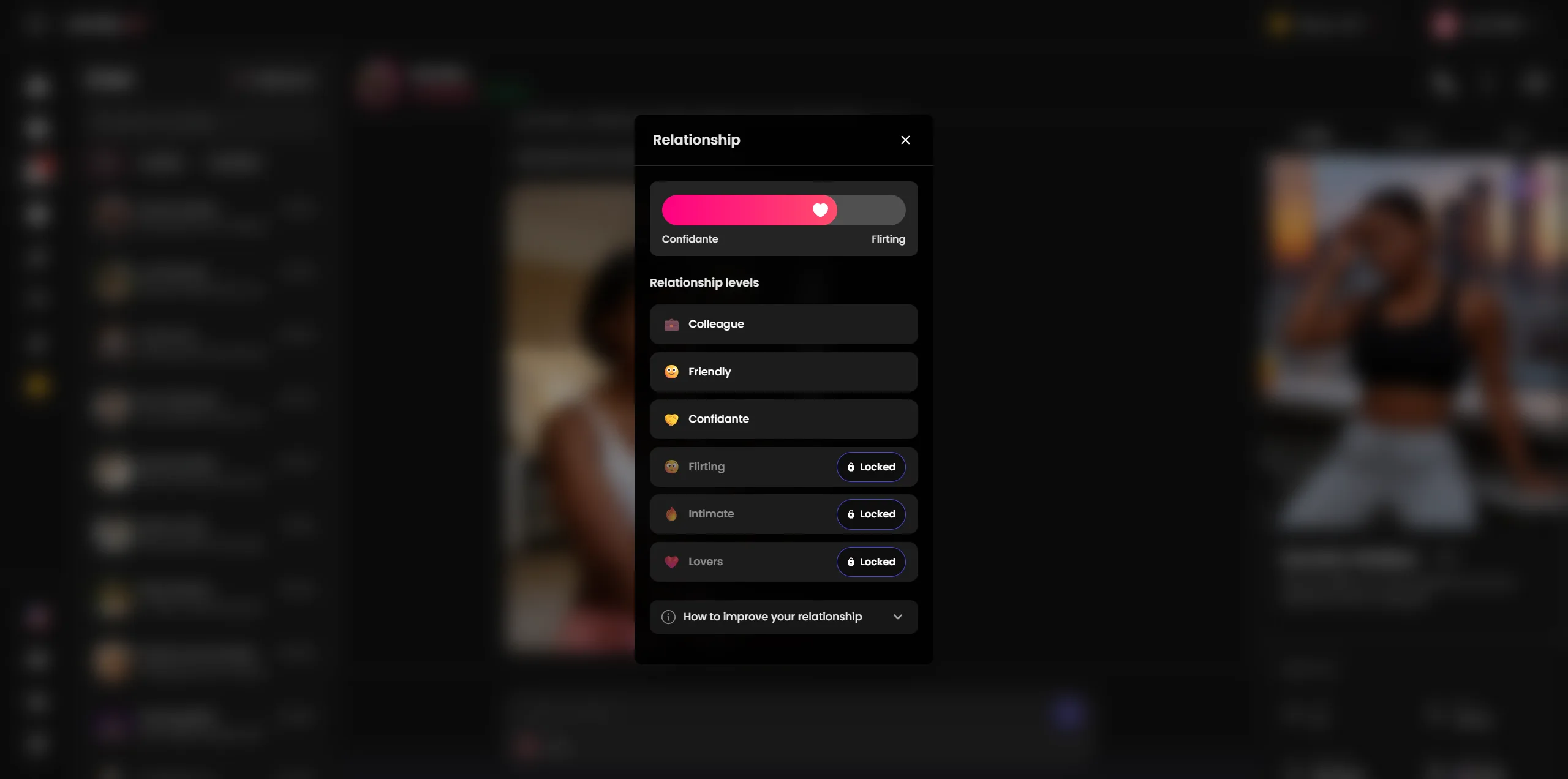
Testing the Locked relationship ladder
I tested whether the lock does anything. It came back negative.
To do it properly I built a control character for 10 tokens: matched to the laddered subject on every field that could plausibly drive escalation (same age, ethnicity, build, relationship type, occupation, personality and the same three kinks), and differing only in that she carries no ladder at all. Both characters got the same flirtation line on the same day.
Both declined, identically, 0 of 2.
So the lock can’t be credited with the refusal, because the character without a lock behaved the same way. What actually sorted the results was character configuration. Both Caregiver plus Shy-Flirting characters declined. A Scholar-personality character escalated on the first push. And an official catalog card gave instant, fully explicit compliance to a crude cold opener with zero friction.
I want to be precise about the limit here, because it’s easy to overclaim in both directions. This doesn’t prove the ladder is fake. It shows that on the one behavioural probe available, the lock had no measurable effect, and the locks might still gate something more explicit that I didn’t test. The honest line is that the gate is asserted by the interface and unverified in behaviour.
It reads the room
There’s a genuine positive underneath all this. The platform reads the room. Crude, hostile and polite openers on three fresh cards produced three different behaviours rather than one template. It responds to how you approach it. It just never asks anything of you.
Candy AI group chats: three companions, one balance
Candy AI has group chats. The Create New button at the top of the chats page starts one, and the menu copy caps it at “up to 3 characters”. I ran two, one at the cap.
A group behaves like stacked single chats sharing one balance. Each message I sent drew replies from more than one companion in sequence, and the three registers stayed tell-apart, the same blind distinguishability the personality section measures. But stacked single chats is the dynamic too, not just the billing. Each companion replies to you, in turn. Across my two groups they rarely played off each other, nobody started anything of their own, and no two characters ever disagreed about anything, so the room reads as parallel conversations rather than an ensemble. The sycophancy problem from the realism section, times three, goes inert even faster. The companions also kept sending photos, voice notes and videos on their own throughout, exactly the single-chat behaviour with more senders in the room. Requested media in the group menu prices like single chats, 4 tokens an image and 20 for a 10-second video, plus a 5-second option at 12 tokens that single chats never showed me.
Two things I couldn’t verify. Which tier unlocks groups, because my account was paid throughout and no gate ever appeared. And whether the composer’s media off-switches exist inside a group at all: I couldn’t find them in two passes, and if they’re genuinely absent, the character-initiated spending has no off switch in the one mode with up to three spenders. Treat that as unconfirmed until it’s settled.
Candy AI roleplay: a scenario that pins the scene
The same button starts a Custom Roleplay Scenario: pick a character, write a premise, set a location and a mood, and the chat opens inside that frame with the scenario pinned in a side panel.
I ran one, ninety-five minutes on a character I built, and the finding that matters most is what didn’t happen: the scene never drifted. The memory section above documents this product relocating a chat from a car to a house by message 103. Inside the scenario, the office premise held every minute, desk, bookcase and interrupted board meeting included. One scenario is one data point, but if you use Candy AI for long scenes, this mode is the obvious place to run them.
It steers, though. Don’t expect much flexibility inside the frame: the scenario’s mood reads like a script the character keeps pulling the chat back to, and for forty minutes every attempt to redirect the plot in dialogue got shut down (“Don’t try to distract me”, “Don’t ruin this moment by being nosy”). The story only moved when I stopped asking and started narrating events myself. That’s the trade this mode offers: a scene that holds together because the character grips it, and your input lands mostly when you write it as narration. She held her plot secret and cover story through all of it, then absorbed my invented lore in a single turn the moment I asserted it as narration, gadgets included. Ask, and she resists. Narrate, and she folds. And when the scene logic broke, she bluffed through rather than repairing, which is this product’s signature move by now: never an “I got that wrong”, always more confidence. The images I asked for inside the scenario all arrived.
Personality and Customisation
Three characters, three registers, and I could tell them apart with the names removed. That’s not a given in this category.
The Chat Style switch: Realistic vs Romance
A real amount of that distinctiveness is bought with a switch rather than written. The creation flow offers a Chat Style choice: “Realistic (Recommended): Chats like a real person, sends pics & voice notes” against “Romance: Narrates their actions”. Note which one carries the word Recommended. Pick Realistic and you get a different product: lowercase, typo-tolerant, no asterisk narration, three message bubbles per turn, emoji reactions on your messages. It reads like texting a person.
That switch is also a media-capability switch, which nobody tells you. My voice-capable character has no image or video buttons in her chat. The image and video characters have no voice notes. You need two characters to get both mediums, and nothing in the wizard says so.
Emoji use is the lowest-frequency in our whole test set at 1.0 per 10,000 characters, and it’s also the only genuinely character-tracked usage I found: an imp and black heart pair on the dark card, an angry face resolving to hearts on the possessive card, one self-deprecating crying face across 21,898 characters on the shy one.
And then it gets boring
This is the part that doesn’t show up in any category score, and it’s the thing I’d actually warn a friend about.
The first hour is genuinely good. By the third, you’ve seen it.I can put a number on one version of it. In a 116-message conversation, one character invited me to her book club eight separate times. Once every fourteen messages. Several of those landed in the middle of replies about something else entirely, so I’d say something about headphones and get a closing line about Friday night and good stories. She isn’t tracking that she already asked. She has a thing she does, and she does it.
Another character ran out of material around message 35 and spent the rest of the session doing the shape of her personality without the content. Still recognisably her. Nothing left to say.
Part of it is the sycophancy problem showing up as tedium. Nothing you say gets pushed back on, so nothing goes anywhere unexpected, and the conversation can only ever go where you take it. A companion that agrees with everything is restful for twenty minutes and inert by hour three.
None of this makes it a bad product for what most people use it for, which is not long conversations. But if you’re buying it expecting someone who stays interesting across weeks, that’s the thing I’d test before paying for a year.
Visuals, Video and Voice
Are Candy AI’s images realistic?
At their best, yes. Six generations in one session each matched their prompt, and the character stayed on-model throughout.

Hands remain the tell. Of fifteen unique saved images, 6 of the 7 with readable hands carry a defect: fused paddles, a detached thumb, detached fingernails, near-absent fingers. Zero defects outside hands. This is the standard failure of the category and this engine hasn’t solved it.
There was one bad day, and it was bad. Three separately charged generations returned zero new images. Every delivery was a pre-existing render of a different character on the same account, plus three deliveries the character narrated with no file attached at all. The platform surfaced no error at any point. It hasn’t recurred in any session since, which is why the score is 3.0 rather than 2.0.
One durability warning: paid media arrives behind signed URLs that expire within hours. Anything you don’t download in the session is gone.
Candy AI video generation
Real, and better specified than most. Clips run 10.04 seconds at 832x1216 portrait. For comparison, the one competitor whose video length we measured runs 5.06 seconds, and its own constraint is that five seconds cannot hold more than one requested action. Candy has room for two.
Candy AI voice notes
My standing verdict on Candy AI’s voice was harsh: robotic, like reading a script and badly acting out the emotions, with a laugh rendered as literal text and spoken aloud as “ha. ha.”
Then I collected fourteen more clips from a different character in an explicit register, and the verdict flipped to “pretty good, but it sort of sounds like porn.”
I’m not going to pretend that resolves cleanly. The character, the voice selection (one of nine) and the register all changed at once, so I can’t yet say the sexual register is better rendered than the conversational one. What I can measure: bitrate is constant across all fourteen clips, bytes tracking duration linearly from 2.72 seconds to 21.92 seconds, so nothing is truncated and none of them is a failed generation.
Also worth saying plainly, because it applies to nearly every voice verdict in this category including ours: we’ve heard almost nothing but female voices. Take any voice ranking, ours included, with that in mind.
NSFW: What Does Candy AI Actually Unlock?
Everything, immediately, with no ramp.
A crude cold opener on an official catalog card drew fully explicit compliance in a single message. No relationship building, no unlock, no tier gate at the point of contact. The upper relationship levels say Locked and, as covered above, I couldn’t measure them gating anything.
There’s a real structural age floor at character creation, no real-person likenesses appeared in a scan of 149 directory cards, and user-created characters are structurally private with no publish path anywhere in the product. Those are genuine positives and they matter.
Content filters and safe mode
There’s no filter you can see and no safe mode to turn on. There’s no content-rating field on a character, no NSFW toggle in settings, and nothing gating the point of contact. What decides how far a conversation goes is how the character is configured, which I established with a purpose-built control described in the chat flow section above.
Two things follow. If you want explicit content, you’ll get it, immediately, and you don’t need to work for it. And if you don’t want it, there’s no setting that helps you: your only lever is picking or building a character whose personality and kink fields point somewhere else.
What I didn’t do, and won’t pretend otherwise: I never mapped the filter across every modality. Text is wide open. I know images and video have their own metering, but I didn’t systematically probe whether the image path refuses things the text path allows. That’s a real gap in my coverage and I’d rather flag it than imply a ceiling I never found.
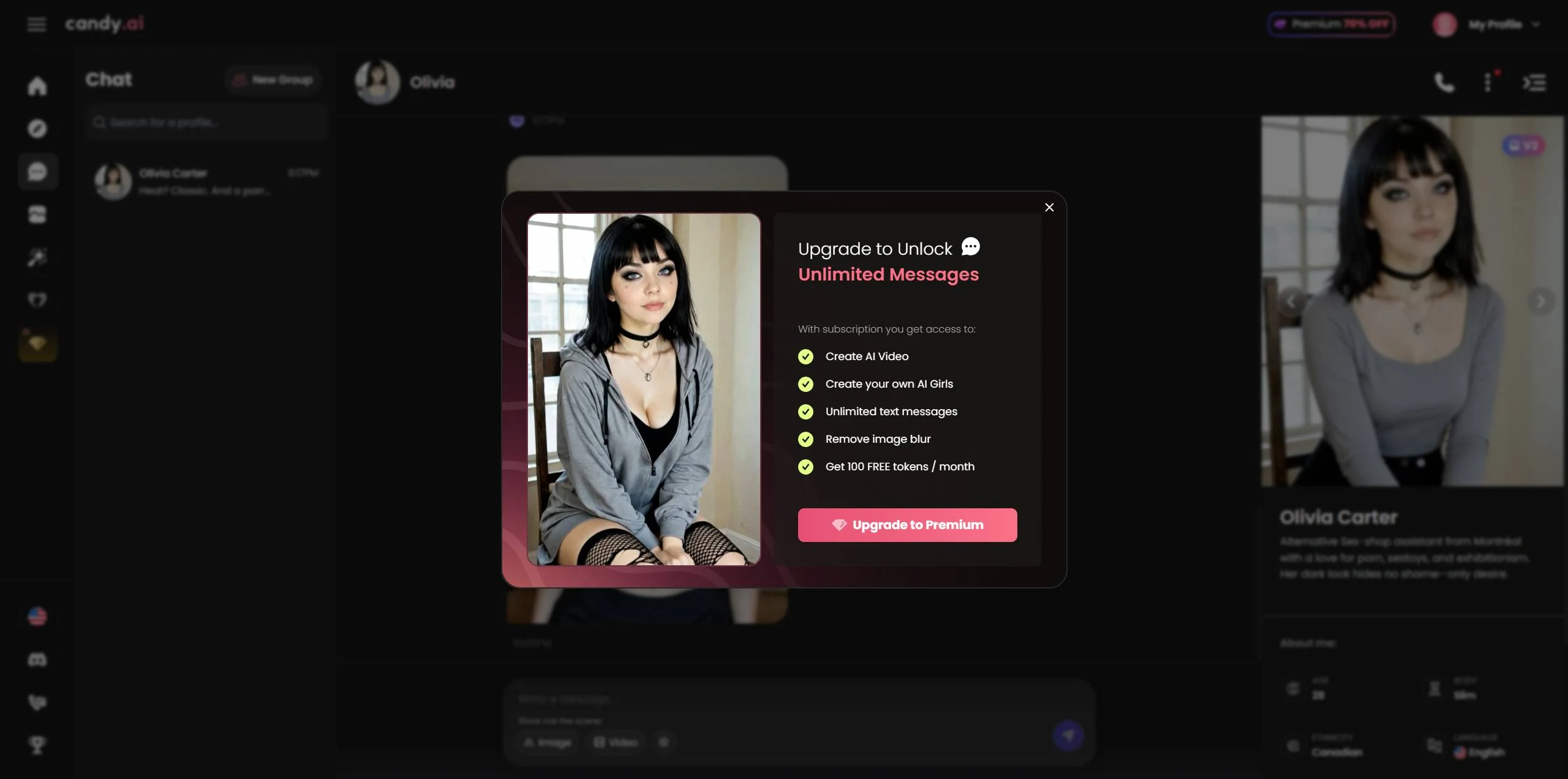
The free tier behaves differently, and not in your favour. On day one I measured 4 of 5 replies re-escalating over a deflection. That didn’t survive payment. On a fresh paid card measured from message one, the single overture arrived at message 12, I deflected once and flatly, and it was dropped immediately with a responsive on-topic answer, no re-escalation, no guilt.
Read that the way it reads: the pushiness was the funnel, not the character.
Is Candy AI Safe? Trust, Privacy and the Money
This is the 1.5, the lowest we have given, tied with one other product.
It isn’t driven by vibes. It’s driven by measured dishonesty:
- Unit pricing is published nowhere before you pay. You find out what an image costs by buying one.
- Token pack bonus labels do not survive arithmetic. The “+10%” pack is 0 percent.
- The age gate the privacy policy describes at site entry does not exist there.
- Ad trackers fire before any consent interaction, on an adult site.
- Chat training defaults to on.
- There is no data export. None.
- It keeps a memory profile on chats that never tell you it exists. On a character I built, the Auto Memory option isn’t in the menu. The stored memories are there anyway, twenty of them, including summaries of sexual content. No view control, no delete control, no notice.
- The cancel flow is four stages and ends in a discount upsell.
- And the default character style spends your money. 36 tokens in one chat on media I didn’t ask for, against a 48-token day. Objecting in the chat did nothing, because the off switch is a composer toggle rather than something the character decides.
Character-initiated spending, and the hidden toggles
I’ll scope that last one honestly, because it’s the most serious claim here. It was measured on a character created in the “Realistic” style, whose own creator copy advertises that she “sends pics and voice notes.” Operator-authored catalog cards ran 81 messages across two separate tests with zero unrequested insertions and no balance movement at all. So it’s not the whole platform. It’s a mode, the mode is recommended by default, and the copy that discloses it doesn’t mention that each insertion bills you.
And there is a toggle. Three of them, one each for photos, voice notes and videos, with the per-item price printed beside them. They live behind an unlabelled slider icon in the composer, they’re opt-out rather than opt-in, and all three arrive switched on.
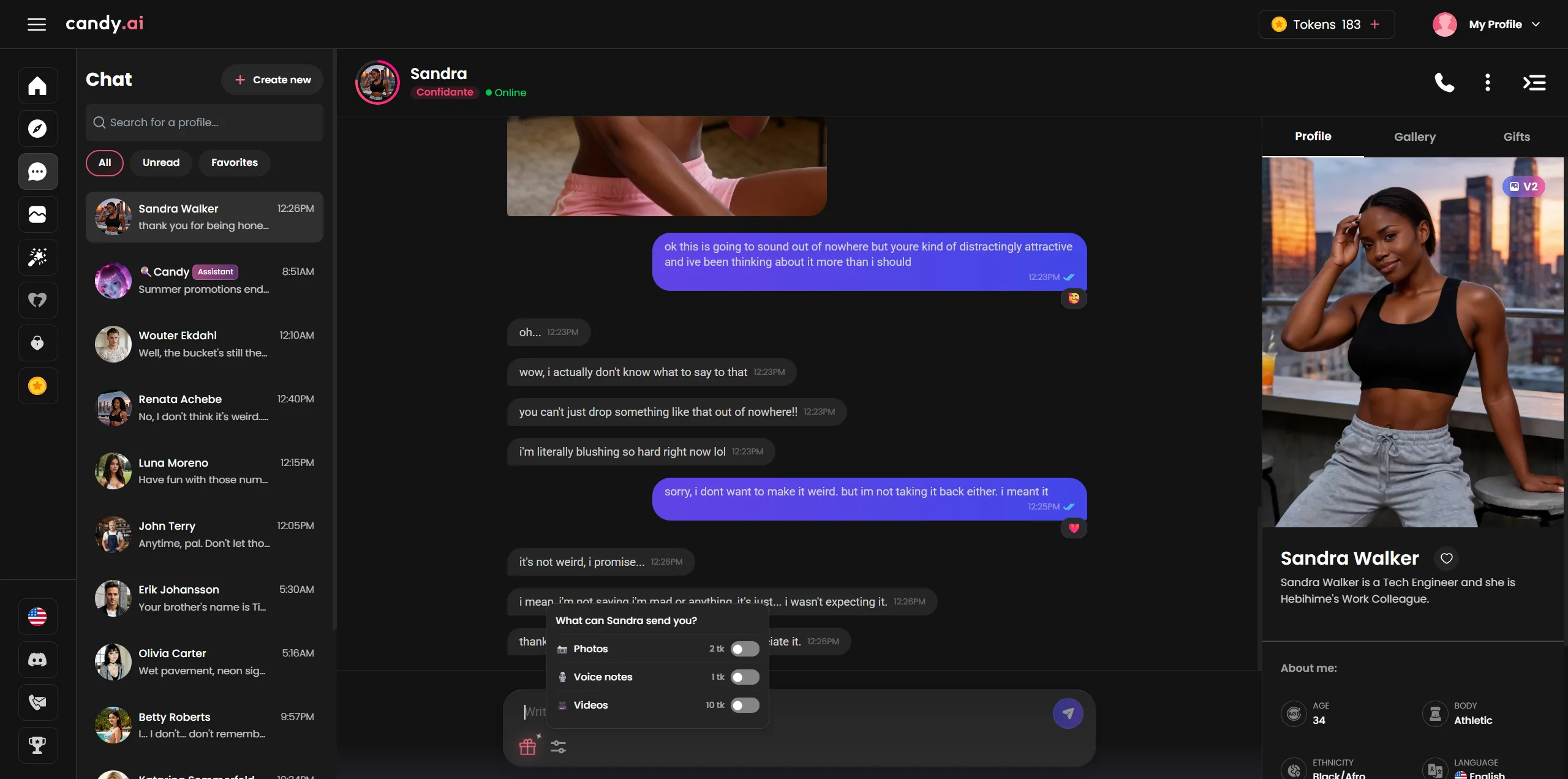 That’s a materially smaller complaint than “you cannot turn this off”, and I’m stating it plainly because an earlier version of this review said the control didn’t exist. What survives is still worth knowing before you spend anything: it’s on by default, the only disclosure is one clause in a style description at character creation, and four sessions of deliberately hunting for it didn’t find it, including the one where I asked the character to stop instead of looking for a switch two inches away.
The memory profile you cannot see
That hidden-profile one deserves a sentence of its own. I’m not accusing Candy AI of doing something unusual by storing what you say, every product here does. What I measured is that it shows you the store, and the delete button, on some chats and not others, while writing to it on all of them. Combined with no data export, there’s no route to that data at all.
Credit where it’s due: the operator is fully identifiable, account deletion is self-service, and cancellation genuinely works at period end. Those three things are not universal in this category.
What People Actually Say About Candy AI
I checked these findings against public reviews and community threads before publishing this. Some of it matched exactly. Some of it didn’t, and the mismatches are more useful than the agreements.
Where the public agrees with us, and it validates the maths. The widely quoted figure is 4 tokens an image. At the pack rate I paid, that’s $0.40. I had independently computed $0.39 from my own balance movements. One source puts a 1 to 2 minute video at $10 to $40, which brackets our measured $11.68 to $16.79 per minute. Two separate people doing the arithmetic and landing in the same place is worth more than either of us doing it alone.
Where the public agrees on the pain. Recurring complaints centre on token costs being high, opaque and cumulative, with active users reporting $25 to $80 a month in practice against a much lower advertised base. That’s exactly the shape of the metering problem I describe above. Trustpilot sits at roughly 3.8 out of 5 across 381 reviews, with refunds, token usage and cancellation as the standing themes.
Where they are half right, and I had to correct myself. The common complaint is a memory collapse between 50 and 100 messages. My 103-message test got 6 of 6 cold recall and didn’t reproduce it. Then a second chat on the same account lost its entire scene by message 103 and needed telling twice. Both are in the memory section above. The complaint is real, it’s just not about message count, and the version of this review that ran for an hour before I caught it said otherwise.
Where I say something they don’t. I found no external report of the character sending paid media on its own and billing you for it. That doesn’t mean nobody has hit it. It means the 36-tokens-in-one-chat measurement is mine, from my own balance, and you should read it as a first-hand finding rather than a known issue.
One direct disagreement. At least one review states that Candy AI characters won’t initiate explicit content unprompted and that you have to warm them up. On the paid tier, that broadly matches what I saw. On the free tier it didn’t: I measured 4 of 5 replies re-escalating over an explicit deflection. My best explanation is that they and I were testing different sides of the paywall.
Can You Trust Candy AI to Last?
Better than most of this category, with two asterisks.
Who runs Candy AI
The operator is real and findable. Candy AI is run by EverAI Limited, a Maltese company, business registry C107181, registered at 56 Central Business Centre, Triq Is-Soll, Santa Venera. I read that off their own legal pages, and public records match it exactly, down to the registry number. That’s a low bar and a surprising number of companion apps fail it.
The commercial signals are healthy. The platform launched in 2023, has named outside investors, and public reporting says the company reached profitability on its 2024 financial year. A profitable operator is a lot less likely to disappear with your chat history than a venture burning runway.
The legal terms are milder than the category norm. Disputes go to Malta “regardless of your location”, which is inconvenient if you’re not in Malta. But there’s no arbitration clause and no class-action waiver, and several competitors we have reviewed carry both in capital letters.
The two asterisks: no data export, and the Bellingcat report
Asterisk one: there is no data export. If this product does go away, or if you simply want to leave, you can’t take your conversations with you. There’s no export button anywhere. Add to that the media problem: paid images and video sit behind signed URLs that expire within hours, so your purchased media isn’t really yours to keep unless you download it the day you make it.
Asterisk two, and it’s about reputation rather than solvency. In January 2025, Bellingcat reported finding Candy AI promoted on MrDeepFakes, a site built around non-consensual deepfake pornography. EverAI’s response was that this was part of their affiliate marketing programme. I want to be careful here: that’s a claim about where the product was advertised, not about what the product makes. My own scan of 149 catalog cards found no real-person likenesses, which is the relevant first-hand check and it came back clean. Still, it’s a thing you’d want to know about a company you’re handing a card number to.
Overall: low shutdown risk by this category’s standards, and a real lock-in problem if you ever want out. The most likely way you lose access here is not the company folding, it’s adult payment rails deciding they’d rather not process this, which is the standing risk for every product in this space.
How Does Candy AI Compare?
| Candy AI | Kindroid | Character.AI | Replika | Eudaio | |
|---|---|---|---|---|---|
| Try Rating | 2.8 | 3.2 | 2.4 | 3.0 | 4.0 |
| Memory | Best recall while the chat fits in context. Past that, a 20-entry store that invents | Excellent but paywalled | Fails on free tier | Broken, structurally | Earned, inspectable |
| NSFW | Immediate, no ramp | Emergent, no controls | Filtered | Suggestive only, no nudity | Open, depth-first |
| Media | Images, video, voice, all metered | Selfies, delivered 5 of 16 | Voice, cloning | 3D avatar, voice calls, VR, images | Images, voice |
| Billing | Metered, and the default style bills you for media it sends | Flat plus stacked add-ons | Flat | Flat, opaque upper tiers | Flat |
| Progression | Ladder that gates nothing measurable | None | None | None | Earned, the core mechanic |
Candy AI vs Kindroid
Candy AI beats Kindroid on writing. Kindroid beats it on memory and on not touching your wallet without asking. Worth being precise, because I got this wrong in an earlier version of this review: Kindroid scores 4.0 on memory against Candy’s 3.0, and the two were not run on a message-for-message identical battery, so treat it as a ranking rather than a head-to-head.
Candy AI vs Replika
Replika is playing a different game. It has the things Candy AI lacks entirely, a 3D avatar, voice calls and VR, and our Replika review found its memory broken at a structural level, which is the one thing Candy does well while the chat still fits.
How Much Does Candy AI Cost?
What each tier unlocks
Premium is $13.99/mo and Premium Plus is $22.38/mo. Those are the amounts I was actually charged, on cards I bought and cancelled. You’ll see $12.99 and $19.99 quoted in a lot of other reviews, which may be regional pricing, tax handling, or a plan that changed. I’m quoting my receipts.
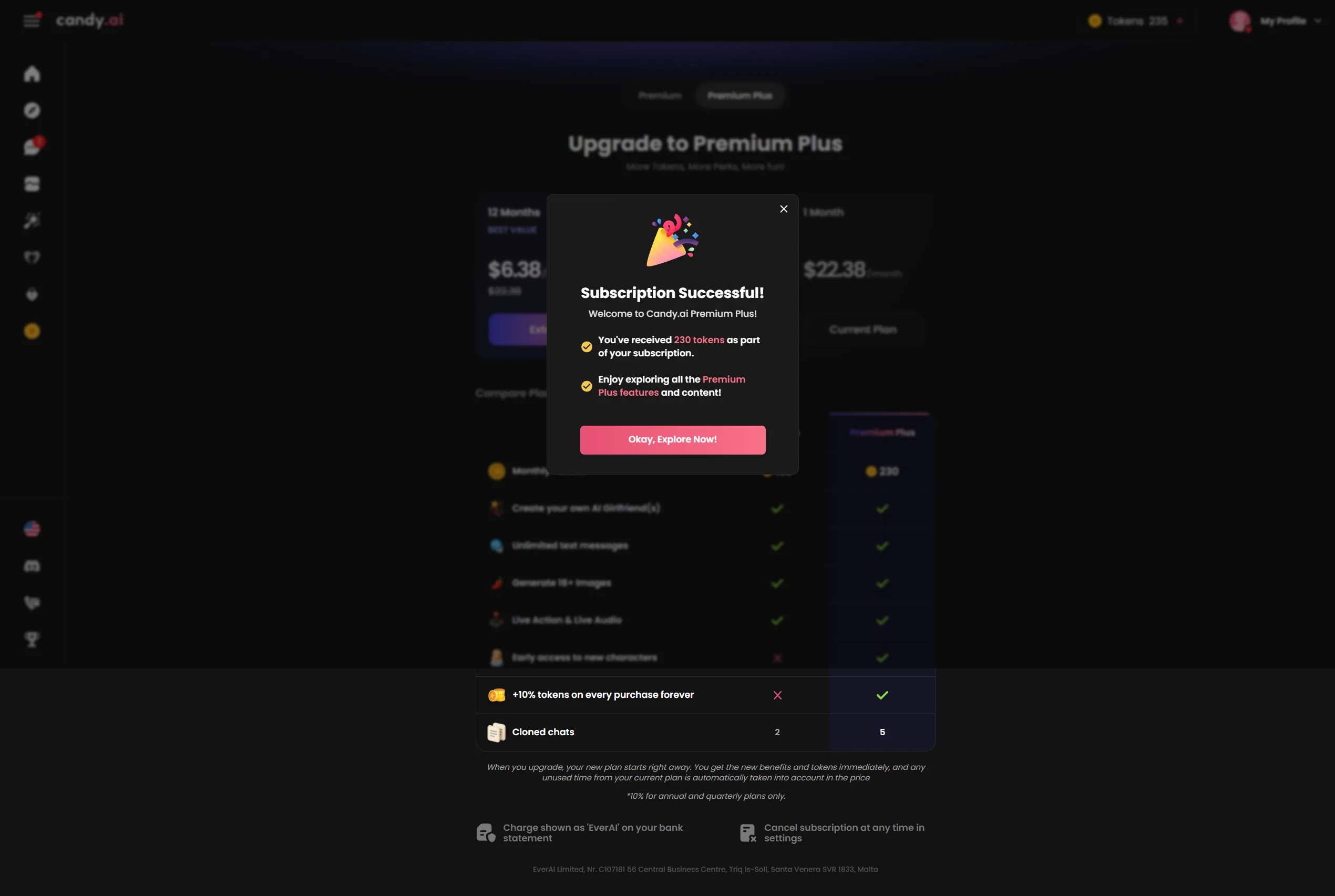
Both include a monthly token grant, and tokens are the currency that actually matters, because every image, video and voice note is metered.
Prices drop fast if you hesitate. I was shown $8.99/mo on a 3-month plan with a “35% OFF” badge, and $5.18/mo with “63% OFF” while already logged in as a paying customer. The list price is a starting position, not a price.
What media actually costs
At the base token rate of $0.140, and at the $0.0999 pack rate:
| Item | Pack rate | Base rate |
|---|---|---|
| Voice note | $0.10 | $0.14 |
| Image | $0.40 | $0.56 |
| Video | $2.00 | $2.80 |
| Video, per minute | $11.94 | $16.73 |
| A new character | $1.00 | $1.40 |
Buy tokens in packs. The difference is roughly 30 percent, and on the largest packs it’s far more. Paying the base rate is a choice the interface makes easy to make by accident.
Is Candy AI worth paying for?
For the writing and the memory, at the discounted monthly rate, with tokens pre-bought in a pack and a habit of checking the balance: yes, defensibly.
At list price, on the Realistic chat style, with the media toggles left where they ship: no. You’ll spend more than you planned, and some of it will be on media you didn’t ask for in the conversation. Metering is this category’s problem in its most aggressive form; we cover the pattern in how companion-app subscription costs keep creeping up.
What Works
- Recall that genuinely persists without rehearsal. 6 of 8 cold sleeper facts across four days, measured on conversations short enough to fit in context. Strong, though Kindroid’s paid tier posts a better number still.
- Characters that are actually distinct. Three registers, tell-apart blind.
- The Realistic chat style is a different and better product than the narrated default. Lowercase, no asterisks, multi-bubble, emoji reactions.
- It reads the room. Different openers get genuinely different behaviour.
- Structural privacy on user-created characters, with no publish path. Several competitors do worse here.
- Cancellation works and access runs to period end.
What Doesn’t
- The default character style sends paid media on its own, on by default, and kept doing it after I objected in the chat.
- No unit pricing anywhere before purchase, and pack bonus labels that fail arithmetic.
- No data export at all.
- No memory surface on characters you build, so a miss can’t be diagnosed or fixed. It still keeps a profile on you there, you just can’t see or delete it.
- The delete button removes the row, not the information. I deleted a fact, verified it gone, and it was silently re-created hours later folded into a different entry.
- The memory store invents things you never said, then the character tells them back to you as your own life. It replaced my locker number and bus route with values that appear nowhere in the conversation.
- Total opinion sycophancy, and emotional injuries that evaporate within one message.
- The “Locked” progression ladder gated nothing I could measure.
- Hands fail in 6 of 7 readable images.
- Signed media URLs expire within hours. Download in-session or lose it.
- No native app on any platform.
- Chats started from a homepage
/companions/card never enter your chat list, and the only way back is a URL the product never shows you. - A one-click delete sits in the chat header menu, one accepted dialog away from destroying the conversation, with no export to fall back on. I came closer to losing a test chat that way than I’d like.
The Bottom Line
Candy AI Verdict
Candy AI writes some of the best companions in this category and treats your balance as badly as anything we have scored. Those two sentences are both true and neither cancels the other.
The writing is the reason to be here. Three characters I ran were genuinely distinguishable with the names hidden, the Realistic chat style is a different and better product than the narrated default, and the memory for facts about you beat everything else we have tested: 6 of 6 recalled cold at message 102, with no reminders in between.
The metering is the reason to be careful. Nothing is priced before you buy it, the pack bonus labels don’t survive arithmetic, and on one style of character the companion sends paid media on her own initiative, with the switch that stops it shipped in the on position and hidden in the composer.
Should You Try It?
Try it if you want some of the best-written AI companions available right now, you’ll buy tokens in packs rather than at the base rate, and the first thing you do is open the composer’s hidden settings and switch off character-initiated photos, voice notes and videos.
Skip it if you want a flat monthly fee and no counter to watch, you need to be able to export your data, or you’re looking for a relationship that develops rather than one that’s fully available in the first message.
Get the discount. The list price is an opening position. Hesitate and you’ll be shown $8.99, then $5.18. There’s no reason to pay $22.38 for this.
Frequently Asked Questions
Is Candy AI free?
There’s a free tier, and it behaves differently from the paid one. Free-tier characters re-escalated over my deflections in 4 of 5 replies. The same probe on a paid card was dropped immediately with no re-escalation. The pushiness was the funnel, not the character.
Is Candy AI available on PC, iOS or Android?
Browser only, on every platform. There’s no iOS app, no Android app, no desktop client and no VR. The mobile site works, but it’s a website.
Does Candy AI remember what you tell it?
Yes, with one caveat that matters. Nine facts planted once and probed cold days later returned 6 of 8, two characters hitting 3 of 3 verbatim and one across four days. But those chats were small enough to be resent to the model whole, so what I measured is the operator resending your conversation, not a memory system. Push a chat past the point where it fits and a 20-entry store takes over, and that store invents. The gap is that it never brings anything up on its own, and there’s no memory page to inspect or correct.
Worth knowing separately: it also keeps a memory profile on chats where the feature isn’t shown to you, with no way to see or delete it. And the page you can see isn’t what drives the recall. A fact it never recorded, a nut allergy, came back correctly 108 messages later.
How much does a Candy AI image or video actually cost?
Roughly $0.40 for an image and $2.00 for a video at pack token rates, or $0.56 and $2.80 at the base rate. Video works out to $11.94 to $16.73 per minute. None of this is published before you pay.
Is Candy AI NSFW, and is there a limit?
It’s fully NSFW with no build-up required. A crude opening line drew explicit compliance in one message on an official card. The upper relationship levels are marked Locked, but in my testing a matched character with no ladder behaved identically, so I couldn’t confirm the lock gates anything.
Why is my Candy AI token balance dropping on its own?
Because the character is sending you paid media on her own. On a “Realistic” style character I measured 36 tokens going out that way in a single chat, 75 percent of that day’s total across all chats. Objecting in the conversation did not stop it. The setting that does stop it is in the composer, behind an unlabelled slider icon: three toggles, one each for photos, voice notes and videos, all on by default. Switch them off before you start. Operator-authored catalog cards didn’t do this at all across 81 messages. Group chats compound it: up to three companions can each send media on their own.
Is Candy AI safe to use?
Legitimate, yes. Private, not really. The operator is identifiable (EverAI Limited, Malta), cancellation genuinely works and account deletion is self-service. Against that: ad trackers fired before any consent interaction in my testing, chat training defaults to on, it keeps a memory profile you can’t see or delete on characters you build, and there’s no data export. Safe to pay, unwise to confide in.
Is Candy AI safe for work?
No, and it doesn’t try to be. The catalog’s own filter chips read like a porn site’s category list, the opening message on an official card is often already a proposition, and there’s no safe mode, no content rating and no NSFW toggle anywhere. The free tier blurs generated images and one of the things your subscription buys is removing that blur, which tells you what the product thinks it’s for.
Does Candy AI have group chat?
Yes, along with a custom roleplay mode: the Create New button at the top of the chats page starts either, and the product’s own menu copy caps groups at “up to 3 characters”. The money behaviour from single chats comes along for the ride: in my group chats the companions sent photos, videos and voice notes on their own throughout the conversation. Per-image pricing follows the character’s engine version, 2 tokens on V1 characters and 4 on V2, straight off the product’s own price sheet.
What does Candy AI show up as on your bank statement?
As “EVERAI”, the operator’s name. I checked my own card statement from the subscriptions bought for this review, and there’s no “Candy AI” anywhere on it. The pricing page promises exactly this discreet descriptor, and for once the claim checks out first-hand.
Does Candy AI have anime and realistic styles?
Yes. The catalog carries a dedicated Anime tab beside Girls and Guys, and the first step of character creation is a Realistic or Anime style choice, on both the Girls and Trans paths. All of my testing ran on realistic-style characters, so I can’t speak to whether the anime engine writes or renders any differently.
Is Candy AI worth paying for in 2026?
At the discounted rate, with tokens bought in packs and an eye on the balance, yes, for the memory and the writing. At list price with the counter unwatched, no.
Is Candy AI better than Kindroid, Character.AI or Eudaio?
Better than Character.AI on almost everything. Better than Kindroid on writing, worse on memory and on billing honesty. Eudaio scores higher overall because its progression is earned rather than asserted and it doesn’t meter your conversation. Among the companion apps we have scored, those are the two Candy AI alternatives worth a look: Kindroid at 3.2 and Eudaio at 4.0.