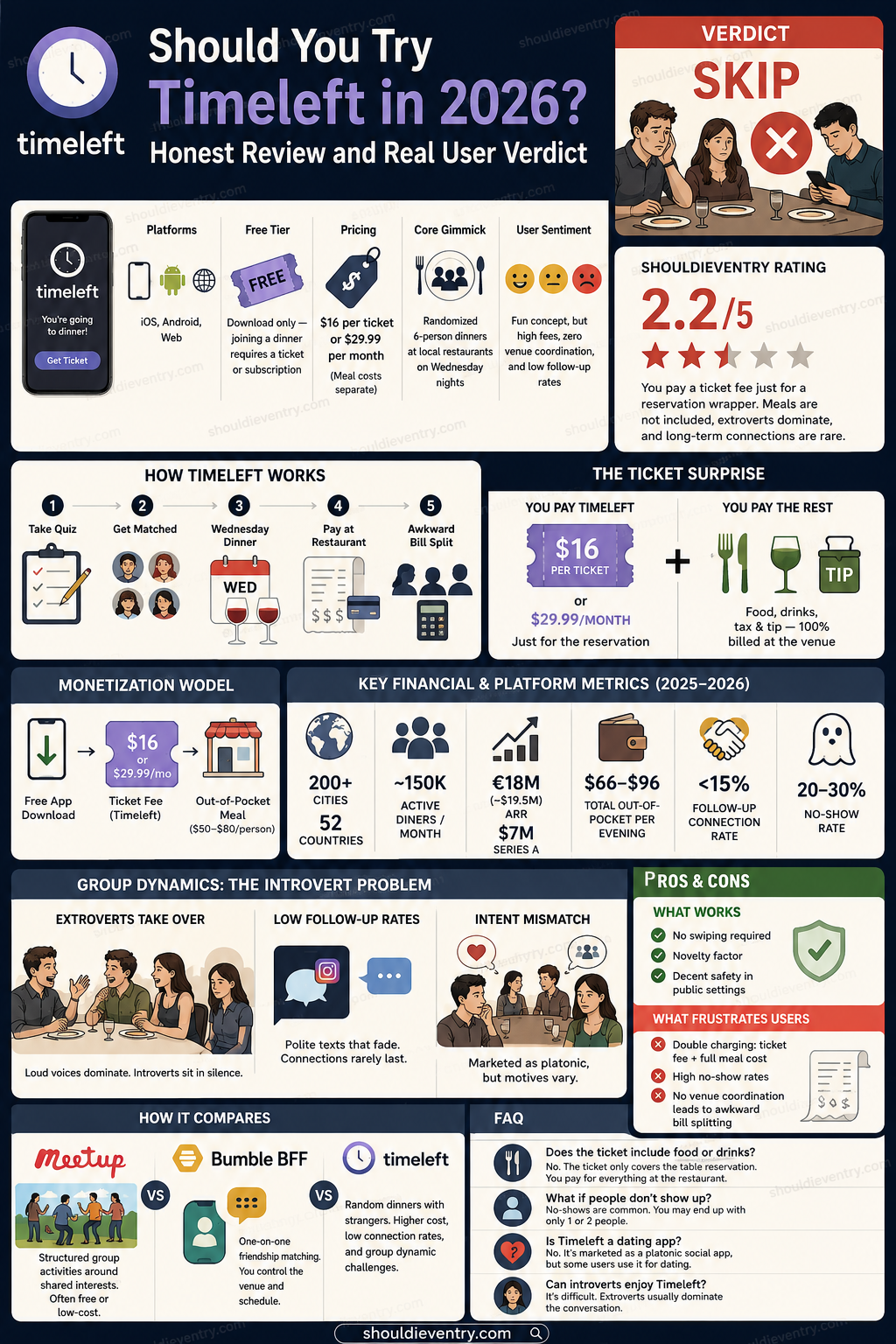
Quick Reference
| Platforms | iOS, Android, Web |
| Free tier | Download only — joining a dinner requires a ticket or subscription |
| Pricing | $16 per ticket or $29.99/month (meal costs billed separately at venue) |
| Core Gimmick | Randomized 6-person dinners at local restaurants on Wednesday nights |
| User Sentiment | Fun concept, but high ticket fees, zero venue coordination, and low follow-up rates |
| Verdict | Skip: overpriced reservation coordinator that leaves most introverts feeling awkward |
Verdict
Timeleft promises magical dinners with strangers, but it functions as an expensive wrapper over standard table reservations. You pay $16 per ticket or $29.99 a month just for the app to pick a restaurant and place a booking. You still pay 100% of your food and drink bill at the venue. For most users, extroverts dominate the conversation, restaurants are uncoordinated, and follow-up connection rates are under 15%.
First Impression
The Setup and the Ticket Surprise
Onboarding is simple. You take a quick personality quiz rating your extroversion, political alignment, dietary habits, and alcohol consumption. Timeleft then assigns you to a 6-person table at a local restaurant on Wednesday evening.
The first disappointment hits when you realize what the ticket actually covers:
- Ticket Fee: $16 per single event or $29.99 per month for unlimited dinners.
- Meal Costs: Not included. You pay for your own food, drinks, tax, and tip directly to the restaurant.
Most first-time users assume a $16 ticket includes an appetizer or drink. It does not. You are paying Timeleft purely to make a group reservation.
Because Timeleft gives no cut of its ticket fee to the venue, restaurant staff usually have no idea what Timeleft is. Waiters treat your table like any standard group reservation. At the end of the meal, splitting a shared bill among six strangers who ordered different items creates an immediate, awkward accounting ordeal.
Monetization and Key Financial Metrics
Timeleft has grown rapidly into a global event coordinator, but its financial model relies heavily on ticket fees layered on top of out-of-pocket dining costs.
- Free app download
- Ticket fee $16 once or $29.99/month
- Meal paid separately $50–$80/person
Fact-Checked Platform Data (2025–2026)
| Metric | Fact / Data Point | Real-World Impact |
|---|---|---|
| Global Scale | 200+ cities across 52 countries | High availability in capital cities; sparse coverage in small towns |
| Monthly Diners | ~150,000 active participants / month | Good critical mass in tier-1 markets, but high table variability |
| Company ARR | €18M (~$19.5M USD) ARR · $7M Series A | Fast corporate revenue growth powered by high ticket margins |
| True Dinner Cost | $66 to $96 total out-of-pocket per evening | $16 ticket fee plus $50–$80 meal/drink bill paid at restaurant |
| Long-Term Retention | < 15% follow-up connection rate | Most post-dinner group chats fade after 24 hours |
| Table Flake Rate | 20% to 30% no-show rate | Planned 6-person tables frequently drop to 2 or 3 diners |
Group Dynamics and The Introvert Problem
Timeleft provides in-app icebreaker questions to guide conversation, but real user experiences highlight clear friction in group dynamics:
- Extroverts Take Over: In a group of six strangers, loud extroverts naturally control the conversation. Introverted participants report spending two hours sitting in silence while extroverts lead the table.
- Low Follow-Up Rates: Repeat users who have attended 7 or more Timeleft dinners confirm that long-term connections are rare. Group members exchange Instagram handles, send a polite text that night, and rarely meet again.
- Intent Mismatch: Timeleft markets itself as 100% platonic. However, because tables are split between men and women, some participants secretly use it as a proxy dating app. This creates uncomfortable tension between participants wanting friends and those scouting for dates.
Pros and Cons
What Works
- No Swiping Required: Takes away the tedious swipe-and-chat routine of standard social apps.
- Novelty Factor: Attending a blind dinner in your city can be a fun one-off weekend experiment.
- Decent Safety: Public restaurant settings make the initial meeting safe for solo attendees.
What Frustrates Users
- Double Charging: You pay a ticket fee to Timeleft plus full price for your meal at the venue.
- Flake Rates: Last-minute cancellations often reduce a 6-person table to 2 or 3 people sitting at a noisy bar counter.
- No Venue Coordination: Restaurants are not informed or compensated, leading to awkward bill splitting.
How Timeleft Compares
If you want structured group activities based on specific hobbies, Meetup offers free or low-cost community events where people bond over shared interests rather than random small talk. If you prefer one-on-one platonic friendship matching where you control the venue and schedule, Bumble BFF remains far more practical.
Frequently Asked Questions
Does the Timeleft ticket price include food or drinks?
No. The $16 ticket or $29.99 monthly subscription only covers the table arrangement made by the app. You must pay for all your food, drinks, tax, and tip directly to the restaurant.
What happens if people do not show up to the Timeleft dinner?
Timeleft attempts to fill tables with six people, but last-minute no-shows are common. If participants flake, you may end up dining with only one or two people.
Is Timeleft a dating app?
No. Timeleft is explicitly marketed as a platonic social app to make friends. However, participant motives vary, and some users attempt to use it for dating.
Can introverts enjoy Timeleft?
It is difficult. Without strong moderation, extroverted attendees usually dominate the dinner table, making it overwhelming for quieter individuals.