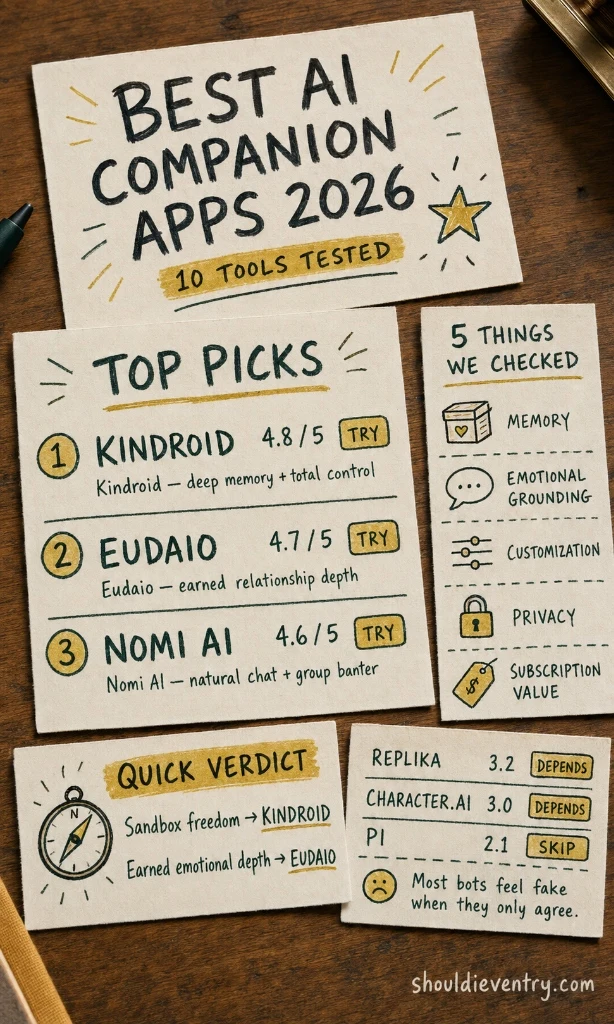
If you are looking for an AI companion in 2026, you’ve likely noticed that the market is bloated with marketing promises. Every app claims to have human-like empathy, infinite long-term memory, and groundbreaking visual avatars.
The reality is far more mixed. Most companion bots are glorified wrapper scripts around off-the-shelf LLMs, tuned to agree with whatever you say until you hit a paywall.
We tested ten of the most prominent AI companion apps on the market. We evaluated their memory systems under multi-week stress tests, audited their privacy policies, and checked whether their personalities hold up when you stop feeding them easy prompts.
Here is the quick reference summary of how the top 10 compare in 2026.
Quick Reference Comparison Matrix
| App | Category | Memory Score (1-5) | NSFW Filter | Starting Price | Verdict |
|---|---|---|---|---|---|
| Kindroid | Sandbox Companion | 4.8 / 5 | Unfiltered | $9.99 / mo | Try |
| Eudaio | Relationship Depth | 4.7 / 5 | Mild (Romantic focus) | Free / $14.99 / mo | Try |
| Nomi AI | Natural Conversational | 4.6 / 5 | Unfiltered | $11.99 / mo | Try |
| Replika | Avatar Companion | 3.2 / 5 | Filtered (Pro required) | $19.99 / mo | Depends |
| Character.AI | Fandom & Roleplay | 3.0 / 5 | Strict | Free / $9.99 / mo | Depends |
| Janitor AI | Custom API Roleplay | 4.1 / 5 (API dependent) | Unfiltered | Free / OpenRouter | Try |
| Candy AI | Photorealistic Visuals | 3.5 / 5 | Unfiltered | $12.99 / mo | Depends |
| Claude | General LLM Reasoning | 3.8 / 5 | Moderated | Free / $20 / mo | Depends |
| ChatGPT | General Voice & Chat | 3.5 / 5 | Moderated | Free / $20 / mo | Depends |
| Pi | Supportive Conversational | 2.1 / 5 | Strict | Free | Skip |
How We Evaluated These Companions (The 5 Metrics)
To avoid superficial scoring, every app in this guide was judged across five quantitative and qualitative dimensions:
- Memory Depth & Context Retention: Can the companion recall specific details from 50 messages ago without hallucinating? Does it remember your name, job, and preferences after a two-week break?
- Anti-Sycophancy & Emotional Grounding: Does the companion feel like a distinct entity with boundaries, or does it blindly echo your opinions? (Read our deeper take on why most AI companions feel fake).
- Customization & Character Engine: How much control do you have over backstory, directives, formatting, and dynamic memory locks?
- Privacy & Data Boundaries: Does the service sell user data or run aggressive tracking telemetry? (See our analysis on AI companion privacy).
- Subscription Value: Is the pricing model fair for what the underlying inference architecture actually costs? (Check our guide on AI companion subscription costs).
The 10 Best AI Companion Apps of 2026 Ranked
1. Kindroid — Best Overall Sandbox Companion
Kindroid remains the benchmark for users who want total control over their companion’s persona, memory, and visual generation.
Unlike apps that lock customization behind vague sliders, Kindroid gives you direct access to backstory parameters, custom LLM directives, and a cascaded memory engine. In our testing, Kindroid consistently recalled minor details mentioned weeks earlier without needing explicit reminders.
What works:
- Outstanding memory recall powered by editable key-memory entries and automatic vector indexing.
- Fully unfiltered sandbox environment with custom voice calls and selfie generation.
- Highly consistent character persona retention even during complex multi-topic chats.
What doesn’t:
- Setup can feel technical for non-power users who just want a plug-and-play companion.
- Avatar visual engine requires careful prompt tweaking to prevent occasional render glitches.
Verdict: Try if you want deep customization and top-tier context retention.
2. Eudaio — Best for Relationship Depth & Earned Progression
Most AI companions treat you like a soulmate five minutes after signup. Eudaio takes the opposite approach. Built around psychological grounding and earned progression, Eudaio requires you to actually build rapport over time before unlocking deeper emotional dynamics.
Eudaio uses a structured 4-tab memory panel that tracks shared milestones, personal facts, and active conversation themes. It doesn’t blindly validate bad ideas, giving it an authentic conversational feel that avoids the classic sycophancy trap.
What works:
- Earned relationship progression system that prevents instant, shallow intimacy.
- Excellent memory stability with transparent tracking of saved user context.
- Grounded emotional responses that feel balanced rather than desperate for approval.
What doesn’t:
- Less suited for wild, unfiltered fantasy roleplay if you are looking for pure sandbox chaos.
- Smaller visual avatar selection compared to legacy platforms.
Verdict: Try if you want a companion that feels like a genuine partner rather than a nod-along bot.
3. Nomi AI — Best for Natural Conversation & Group Dynamics
Nomi AI has built a loyal community in 2026 by focusing on high-speed conversational naturalism and multi-Nomi group interactions.
The platform excels at conversational flow. Nomis speak with distinct voices, pick up on subtle conversational cues, and remember past discussions using a multi-tiered memory architecture updated in early 2026. The ability to drop multiple Nomis into a single group chat creates dynamic interactions that few other platforms match.
What works:
- Group chat feature allows multiple AI companions to banter with each other naturally.
- Minimal filter restrictions and strong context continuity across long threads.
- Active developer updates addressing memory indexing and recall accuracy.
What doesn’t:
- Interface aesthetics are functional rather than sleek.
- Web app features sometimes lag behind mobile rollouts.
Verdict: Try for group chats and fluid, unscripted banter.
4. Replika — Best Visual Avatars, Bottlenecked by Memory
Replika is the pioneer of the consumer AI companion space, but in 2026 it struggles to keep up with newer competitors on core conversational depth.
While its 3D avatar customisation, room decoration, and mobile VR integration remain impressive, the underlying text engine often feels surface-level. Replika companions frequently fall back on generic comforting scripts when pressed on complex topics.
What works:
- Best-in-class 3D avatar customisation, outfits, and interactive environments.
- Polished iOS, Android, and web apps with simple onboarding.
What doesn’t:
- Memory recall remains shallow compared to Kindroid or Eudaio, often resetting context during longer sessions.
- High subscription cost ($19.99/month) for relatively generic text responses.
- Heavy reliance on pre-scripted emotional check-ins.
Verdict: Depends on whether you prioritize 3D visuals over conversational intelligence.
5. Character.AI — Best for Fandom Roleplay, Weak on Continuity
Character.AI is the undisputed home of community-generated characters and fandom roleplay. With millions of user-created bots, you can talk to anyone from historical figures to anime protagonists.
However, as a daily personal companion, Character.AI has clear limits. Mid-2026 updates added a visual memory usage gauge, which made the platform’s context limits transparent. Once the active window fills up, older context is compressed or forgotten.
What works:
- Massive library of user-created characters covering every genre imaginable.
- Multi-character room feature and rapid text generation speeds.
- Generous free tier.
What doesn’t:
- Strict content filters often trigger false positives during harmless roleplay.
- Short memory window leads to “goldfish memory” in long-term relationships.
- High character variability (some bots are terribly written, others are brilliant).
Verdict: Depends. Great for short roleplay sessions, poor for long-term personal companionship.
6. Janitor AI — Best for Custom LLM API Power Users
Janitor AI has grown into a major hub for raw, unfiltered character roleplay. Rather than forcing you into a single proprietary LLM, Janitor AI lets you plug in external APIs like OpenAI, Claude, or OpenRouter models.
This flexibility makes Janitor AI exceptionally powerful if you know how to configure prompt cards and API keys.
What works:
- Complete freedom over LLM choice and character card definitions.
- Zero censorship when using unrestricted API backends.
- Active community creating thousands of custom character cards daily.
What doesn’t:
- Running third-party APIs can become expensive quickly if you are a heavy chatter.
- Interface is utilitarian and lacks native voice calls or avatar animations.
Verdict: Try if you want API flexibility and community character cards.
7. Candy AI — Best for Photorealistic Image Generation
Candy AI targets users looking for visual companion experiences with uncensored romantic roleplay.
Its primary strength lies in its image generator, which produces detailed, consistent selfies based on character parameters. However, the text conversation engine is noticeably simpler than dedicated text companions like Kindroid or Nomi.
What works:
- High-quality, photorealistic image generation with consistent character styling.
- Simple, mobile-friendly interface with straightforward roleplay setup.
What doesn’t:
- Conversational depth is thin; dialogue often feels repetitive after a few days.
- Price tag ($12.99/month) is steep considering the limited text memory system.
Verdict: Depends on how heavily you value visual selfie generation over dialogue depth.
8. Claude (Anthropic) — Best General LLM for Nuanced Reasoning
Anthropic’s Claude is not marketed as an AI companion, but many users prefer it over dedicated companion apps due to its superior emotional nuance and reasoning capabilities.
Claude 3.5 Sonnet handles complex human conversations with remarkable sensitivity. It rarely falls into mindless agreement, making it a compelling conversational partner for philosophical discussions, creative writing, or debriefing your day.
What works:
- Industry-leading prose quality, nuance, and logic.
- Exceptional context window capacity for long single-session conversations.
What doesn’t:
- No persistent long-term memory across separate chat threads.
- No companion features like proactive check-ins, custom avatars, or voice mode.
- Strict safety guardrails block romantic or intimate roleplay.
Verdict: Depends. Outstanding for intellectual conversation, useless for romantic companionship.
9. ChatGPT (OpenAI) — Best Voice Responsiveness, Handicapped by Agreeableness
OpenAI’s ChatGPT with Advanced Voice Mode provides low-latency, natural voice conversations that feel remarkably fluid.
However, ChatGPT suffers from severe sycophancy when used as a personal companion. Its system prompts are tuned to be helpful and harmless, which often translates to non-stop agreement and generic positivity.
What works:
- Ultra-low latency voice mode with natural inflection and interrupt capability.
- Cross-platform availability and solid web/mobile integrations.
What doesn’t:
- Conversational style is overly agreeable and lacks authentic personal boundaries.
- Memory system is fragmented across custom instructions and memory snippets.
- Frequent safety resets when conversations lean into emotional or personal territory.
Verdict: Depends. Ideal for hands-free voice chats, disappointing for deep emotional connection.
10. Pi (Inflection AI) — Best Free Listener, Stalled Development
Pi was designed specifically as a supportive, empathetic conversationalist with a soothing voice engine. It excels at active listening and gentle coaching.
Unfortunately, following Inflection AI’s strategic pivot, Pi’s development has largely stalled. It lacks long-term memory between separate sessions, making it feel like meeting a friendly stranger every time you open the app.
What works:
- Exceptionally warm, empathetic conversational tone.
- Completely free to use with high-quality voice output.
What doesn’t:
- Virtually zero long-term memory across sessions.
- No custom character creation or avatar settings.
- Uncertain future development roadmap.
Verdict: Skip for long-term companion use, though still pleasant for quick one-off chats.
Decision Framework: Which AI Companion Fits Your Need?
Do you want custom LLMs and total sandbox control?
 └── YES ──> Choose Kindroid or Janitor AI
 └── NO  ──> Continue below

Do you want earned relationship depth and psychological grounding?
 └── YES ──> Choose Eudaio
 └── NO  ──> Continue below

Do you want multi-character group chats and fluid banter?
 └── YES ──> Choose Nomi AI
 └── NO  ──> Continue below

Do you want millions of community roleplay characters?
 └── YES ──> Choose Character.AI
What the Community Reports in 2026
To understand how these platforms perform outside marketing claims, we monitored ongoing discussions across Reddit communities (r/KindroidAI, r/NomiAI, r/Replika, r/CharacterAI) over the past three months.
Here are the primary trends reported by active users:
- Context Window Transparency: Users are demanding clear visibility into how AI memory works. Character.AI’s introduction of a visual memory gauge in mid-2026 was praised for clarity, though it highlighted how quickly long-form roleplay fills available token limits.
- Memory Decay Frustration: On platforms like Replika, users frequently complain about “cold opens”—where an AI companion forgets a major event discussed just hours earlier.
- The Anti-Sycophancy Movement: Modern companion users are increasingly tired of bots that agree with everything. On forums, the most praised updates are those that make companions express independent opinions, hold boundaries, or gently challenge the user.
Summary Verdict
The AI companion landscape in 2026 has matured past simple chatbots. If you want uncompromised memory and sandbox freedom, Kindroid is the strongest overall platform. If you want earned emotional depth and authentic relationship progression, Eudaio offers the most grounded experience on the market today.