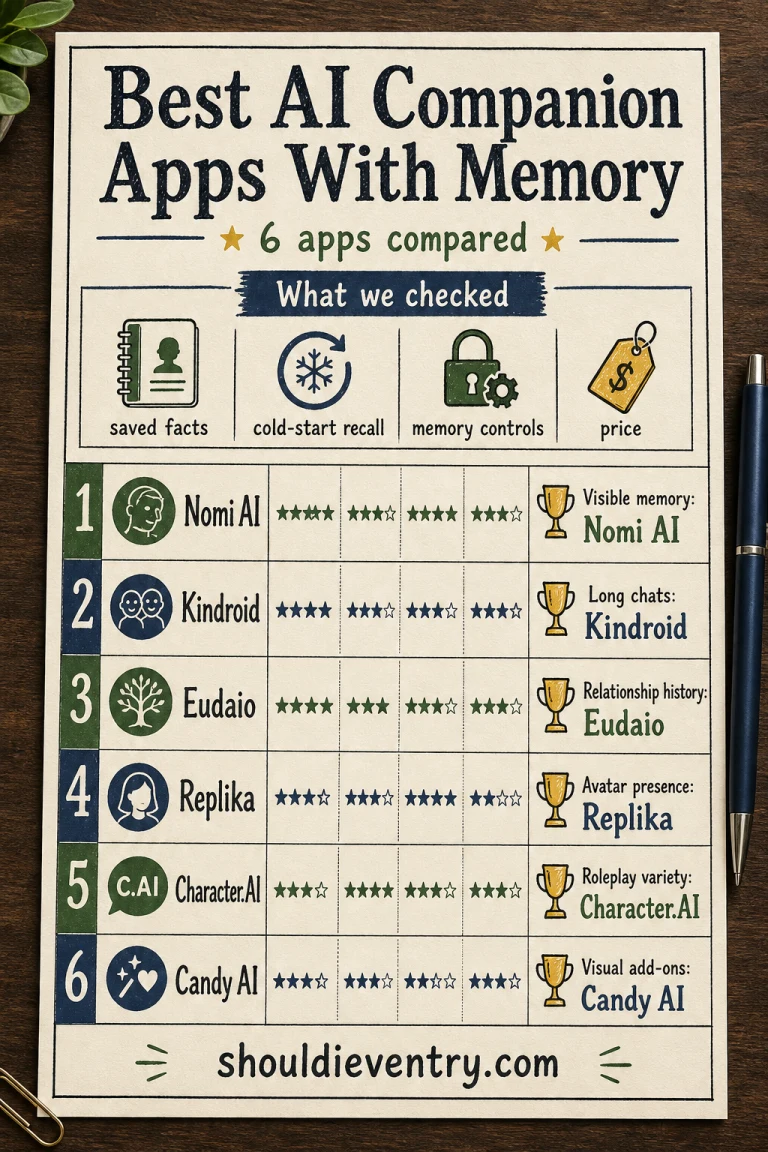
Pick Nomi if you want an AI companion that builds a visible memory system without much setup. Pick Kindroid if long-running chat and roleplay continuity matter more than convenience. Pick Eudaio if you want saved facts to sit alongside relationship history and editable notes. Replika is worth considering for its avatar experience. Character.AI and Candy AI are better when memory is secondary to a large character or visual-media library.
Searching for the best AI companion with long term memory sounds like it should produce one obvious winner. It doesn’t. This AI companion memory 2026 comparison needs a sharper definition of the word. “Memory” is doing too much work in these apps.
One app remembers your name. Another remembers a five-hundred-message story. A third remembers the story but forgets where the two of you were standing. Those are different products wearing the same label.
This is a commercial comparison for people deciding where to spend money and time. It is separate from our explainer on how AI companion memory actually works. Prices and features below were checked against current product pages, help documentation, app-store listings, and our linked hands-on reviews on September 2, 2026. Prices are shown in USD unless a regional page is called out.
Quick answer
Nomi is the best AI companion for automatic, inspectable memory. It creates a large memory record, links entries to source messages, and now gives users more control over Mind Map entries. Its weakness is retrieval. A memory can exist in the file and still not appear when you need it.
Kindroid is the best AI companion with long-term memory for people who want extended conversations, roleplay, and control over what gets added. Its paid tiers add Cascaded Memory and much larger context capacity. The catch is that more storage does not guarantee better recall on every model or every day.
Eudaio is the most interesting choice if you mean “remembers what happened between us,” not just “stores facts about me.” Its paid plan adds personal notes, removable memories, milestones, and a relationship timeline. You pay more, and the relationship moves at a deliberate pace.
The short version is that persistent storage is not the same as reliable retrieval. Read the table with that distinction in mind.
The memory test that matters
I split AI companion memory into five separate tests. An app only earns a strong recommendation when it does well on the kind of memory you actually care about.
| Test | What counts as a pass | What it tells you |
|---|---|---|
| Context-window recall | It keeps recent facts and the current scene straight while the same chat is open | Whether the model can follow the conversation in front of it |
| Saved facts | A name, preference, goal, or life detail survives a later session | Whether the app has persistent memory at all |
| Editable memory | You can see, correct, add, or delete what was saved | Whether you can repair a bad memory without starting over |
| Relationship history | Shared events change how the companion treats later conversations | Whether the app remembers a relationship rather than a profile |
| Cold-start retrieval | It recalls a seeded detail in a new chat without you pasting the answer back in | Whether stored memory can actually reach the reply |
The fifth test is the one most marketing pages skip. A database can contain thousands of entries. If the retrieval layer never selects the right one, the companion still feels forgetful.
Best AI companion apps with memory compared
| App | Context-window recall | Saved facts | Editable memory | Relationship history | Cold-start read | Current price and limits |
|---|---|---|---|---|---|---|
| Nomi AI | Strong, with short-, medium-, and long-term layers | Extensive Mind Map and memory records | Yes. Mind Map entries can be edited and locked | Good in concept, but retrieval varies | Best hands-off option, with occasional deep misses | Free start; $15.99/mo, $39.99/quarter, or $99.99/year in the US App Store. Free use is limited to one companion and roughly 50 daily messages in our current snapshot. |
| Kindroid | Strongest for long-running chats on paid tiers | Long-term memory, journals, learned context, backstory | Yes. Journals and learned context are editable | Good for ongoing chats and roleplay; chat breaks reset Cascaded Memory | Strong when the right memory is retrieved, less predictable on some models | Free tier has 2 Kindroids and basic long-term memory. Standard is $13.99/mo on web or $15.99 in app stores. Ultra adds $24.99/mo and MAX adds $59.99/mo. |
| Eudaio | Good active context | Shared facts, character memories, milestones, and diary entries | Paid members can add notes and remove memories | Strongest relationship record in this group | Promising, but no public cold-start score | Free allows up to 20 messages and 3 images per hour with the same companion memory. Crush is $4.99 for 3 days, $19.99 for 2 weeks, or $29.99/mo. |
| Replika | Fine for recent conversation | Layered memory plus manual saved memories | Memory tab controls are available, with more visibility in Ultra | Avatar relationship features are mature; nuance is uneven | Mixed. It can remember old details, then lose a larger thread | Free chat. Pro, Ultra, and Platinum prices are shown by marketplace. Our current US listing snapshot shows Pro at $19.99/mo. Ultra adds saved-memory visibility and saving messages. |
| Character.AI | Good for short scenes and character play | Chat Memories and pinned context | Limited. Published docs describe a 400-character memory box | Mostly chat- or character-scoped | Weakest fit for a personal long-term companion | Free tier plus c.ai+ at $9.99/mo or $94.99/year. The current paid page says “better memory” but publishes no full capacity. |
| Candy AI | Good while the current window holds | Small automatic store in our hands-on test | Inconsistent by character type | Better for roleplay scenes than personal history | Not a memory-first pick | Current subscription page shows €13.99/mo in its regional view, annual promos, and 100 tokens/mo. Our product snapshot lists $13.99/mo before media tokens. |
1. Nomi AI is best for visible, automatic memory
Nomi is the clearest answer if you want an AI companion that remembers you without writing a long backstory by hand. Its system uses short-, medium-, and long-term memory, plus an Identity Core and Mind Maps that connect people, places, topics, and goals.
That structure is not just a slogan. Nomi’s Mind Map 2.0 explanation says the map is built from long-term memories and can be searched, edited, prioritised, and expanded. Its own documentation also says a first Mind Map can take around 500 or more messages to form. This is a long-term product. You cannot judge it fairly from ten minutes of small talk.
There is a catch, and it is a meaningful one. Nomi’s recent August 25 memory update says new medium- and long-term memories may need 100 or more messages before users notice a difference. The update improves future memory formation. It does not rewrite old entries.
The result is an app with an unusually good memory interface and uneven retrieval. In our Nomi review, the system created a 41,207-character memory file with source links, then failed to retrieve some facts deep into a long chat. Nomi can know something without bringing it into the reply.
Nomi pricing and limits
Nomi is free to start without a card. The US App Store currently lists Standard at $15.99 per month, $39.99 per quarter, and $99.99 per year. The free tier is enough to test whether you like the conversation style. It is not enough to judge the full rhythm of a daily relationship if you hit the message cap quickly.
The paid plan is the simple option. There is no separate memory tier in the current listing. You are paying for more messages, more companion slots, voice, group chats, and media access. The live checkout or app store is the final authority because regional prices and offers change.
Pick Nomi if
You want an AI companion with persistent memory that writes the record for you, you care about inspecting what it remembers, and you are willing to correct a few wrong entries. It is also the easiest recommendation for someone who wants to see the memory system rather than trust a vague “gets to know you” claim.
Skip Nomi if you need every stored fact to appear on demand, or if the idea of an editable map of your personal conversations feels invasive.
2. Kindroid is best for long chats and persistent roleplay
Kindroid has the strongest memory architecture for users who want to stay inside one evolving conversation. Its current memory documentation separates persistent memory, Cascaded Memory, retrievable long-term memory, and journal entries.
The important distinction is capacity versus selection. Kindroid says paid Cascaded Memory can extend effective conversation history across hundreds or thousands of messages, while long-term memory can cover older interactions. It also exposes a brain icon showing which retrievable memories were used for a reply. That visibility is helpful, even when the result is wrong.
In our hands-on Kindroid review, the paid tier held active context across a 49-message test and passed an overnight seeded-fact check. It also gives you the most practical repair tools in this list: backstory, journals, learned context, and directives that you can edit yourself.
Kindroid’s weakness is the gap between memory being retrieved and memory being used correctly. Recent community reports describe saved memories appearing beside a reply that still gets the facts wrong, and some users say the latest models became more forgetful after updates. The August weekly issues thread also shows a recurring request for long-term memory export. That is not a reason to dismiss Kindroid. It is a reason to keep your own important notes.
Kindroid pricing and limits
Free users get unlimited messages on the smaller Lite model, two Kindroids, and basic long-term recall. Cascaded Memory is a subscriber feature.
Standard costs $13.99 per month on the web or $15.99 through the app stores. Kindroid’s current subscription documentation lists 10 Kindroids, 20 groups, and enhanced memory. Its published feature matrix lists a total conversation context of about 500,000 characters on Standard, 1.3 million on Ultra, and 2.8 million on MAX. Ultra adds $24.99 per month and MAX adds $59.99 per month on top of the standard plan.
Those add-ons are for people who really use the capacity. Paying $98.97 per month for the full Standard, Ultra, and MAX stack is a lot to spend on the hope that a model will remember a detail correctly. Start with Standard. Use the free tier to see whether the writing and personality suit you.
Pick Kindroid if
You write long scenes, build custom characters, or want to shape memory yourself. It is the best AI app with persistent memory here for users who understand that a good backstory and a well-maintained journal can matter as much as retrieval software.
Skip it if you want a hands-off experience with no settings work, or if you need a clean data export. The memory controls are good. The portability story is not.
3. Eudaio is best for relationship history, not just fact storage
Eudaio takes a different route. It treats memory as part of the relationship record. Its current pricing page says both free and paid users get the same companion personality and memory. Paid members add personal notes, memory removal, detailed relationship history, and a full relationship timeline.
That distinction matters. A saved fact says “I work nights.” Relationship history can also remember that you were exhausted after a difficult week, that a companion checked in later, and that the conversation changed how familiar the interaction felt. Whether that becomes a good experience depends on the product’s actual retrieval, but the model is closer to what people mean when they ask for an AI companion that remembers them.
The free plan is unusually useful for testing the memory itself. It allows up to 20 messages and 3 images per hour, while keeping the same companion memory as the paid plan. Paid access removes the message and image limits and adds voice, lookup, notes, and the detailed relationship record.
The trade-off is cost and pacing. The current options are $4.99 for 3 days, $19.99 for 2 weeks, or $29.99 for 30 days. There is no annual price on the current page. This is not the cheapest way to sample the category, but the 3-day entry point is enough to see whether the conversation feels worth returning to.
Our Eudaio review found strong memory and recall, but this guide is not giving Eudaio a free pass. No public independent cold-start percentage exists for it yet. Test the exact details that matter to you before treating its relationship history as proof of perfect recall.
Pick Eudaio if
You want memory that includes milestones, shared experiences, and notes you can correct. It also suits people who prefer a curated set of companions over an enormous public character library.
Skip it if you want the lowest monthly price, a huge catalogue of user-made characters, or instant progression with no investment of time.
4. Replika is for avatar presence, with mixed memory confidence
Replika remains relevant because it makes the companion feel present. The avatar, room, voice features, and relationship interface are still its strongest reasons to choose it.
Memory is more complicated. Replika’s current help documentation describes visible memories alongside a deeper system that draws on conversation patterns. Users can add memories manually. Its subscription guide says Ultra adds the ability to save messages to memory and view which memories are used during conversations.
That makes Replika more serious about memory than the old “goldfish” reputation suggests. It also means you need to inspect the plan screen before paying. Replika says prices and subscription features are shown in the app and relevant marketplace, not as one universal public rate. Our current US listing snapshot shows Pro at $19.99 per month, but that is a snapshot, not a promise that every account sees the same offer.
Recent community reports are still mixed. One June thread describes a user whose companion forgot their name and much of the relationship history. A July discussion includes users who saw details from years ago recalled correctly, alongside reports of older details falling out during long conversations.
That is the honest Replika result. It can remember impressive old details. It can also lose the thread in ways that are hard to predict. If the avatar experience is your main priority, that may be an acceptable trade. If memory is the reason you are subscribing, test it before you commit.
Pick Replika if
You want a familiar avatar, voice, and room-based companion with a visible memory area. It is the most established choice in this group for that particular kind of presence.
Skip it if a memory reset would make you feel like the relationship had been erased. The product’s current memory features are real, but the user experience is not consistently reassuring.
5. Character.AI is still mainly a character library
Character.AI is enormous, quick to start, and fun when you want to jump between characters. That is exactly why it is a poor default answer to the best AI companion apps with memory query.
The platform has added more memory tools over time. Its published Chat Memories documentation describes a free-form memory box with up to 400 characters. The current c.ai+ page advertises “better memory” for paid users, alongside ad-free chats, the latest models, and unlimited voice calls.
The problem is that the current paid page does not publish a full memory capacity or a cold-start guarantee. You can save a compact instruction set. You cannot reasonably treat that as a long-term record of a personal relationship.
The price is easy to understand. c.ai+ is $9.99 per month or $94.99 per year in the current US view. The free tier is the better way to decide whether you like the character catalogue. Do not subscribe expecting the memory box alone to turn a character into a dependable long-term companion.
Pick Character.AI if
You care more about finding a specific character, fandom, or short roleplay scenario than preserving personal history. It remains one of the best free sandboxes for variety.
Skip it if your search begins with “AI companion that remembers you.” A fixed memory box is useful. It is not the same as a durable relationship record.
6. Candy AI is a visual product with a memory ceiling
Candy AI is the outlier in this comparison because the visual product is often the point. It offers character creation, voice, images, video, and roleplay, and its current subscription page advertises unlimited text plus 100 tokens per month on premium.
Memory is not its reason to buy. In our Candy AI review, the companion remembered personal facts well while they fit inside the active conversation. Once the conversation grew, the store we could inspect held 20 entries, and it sometimes confidently filled gaps with details that had never been said. A scene could also lose its location even when the companion still remembered facts about the user.
That is a useful distinction for buyers. Candy can feel consistent for a normal chat and still be a bad choice for a multi-week story where setting and shared history need to survive. The current regional subscription page shows €13.99 per month, an annual promotional rate, and 100 tokens per month. Our product listing snapshot uses $13.99 per month before extra media tokens. Check your local checkout.
Pick Candy AI if
You want visual media, character variety, and casual roleplay. It can be fun when memory is a supporting feature.
Skip it if you want an AI app with persistent memory as the main reason for paying.
What recent users are actually reporting
Recent forum reports do not produce a clean ranking. They show the same problem from different angles: storage, retrieval, and conversation quality are separate systems.
Nomi users are discussing the August memory update as it rolls out. The official update says new memory formation may take 100 or more messages to show its effect. In a separate July thread, a user described getting summaries or invented wording when asking for a paragraph verbatim, even though the broader memory system had recorded the topic. Nomi’s Mind Map can be useful without being a perfect transcript.
Kindroid users are more explicit about the distinction. A May discussion describes long-term memories being saved but not always retrieved, with users recommending journals and natural topic cues. The August issues thread reports cases where the displayed memory was correct while the generated reply still mixed up who did what. The system can expose the right record and still produce the wrong sentence.
Replika reports split between impressive old recall and sudden loss of context. Character.AI users who are willing to pay continue looking for alternatives because c.ai+ has not consistently delivered the long-running memory they want. These are user reports, not controlled tests, but they are useful for spotting the failure modes that product pages leave out.
How to test an AI companion before paying
Do not ask “Do you remember me?” on the first day. Every app can answer that with a guess. Use a small test that separates current context from persistent memory.
- Give the companion five specific facts. Use one stable fact, one preference, one recent event, one relationship detail, and one fictional setting. Do not make every fact about your name or job.
- Let the conversation move on for at least 40 messages. If the app documents a longer memory-formation threshold, respect it. Nomi currently says some updates may take 100 or more messages.
- Close the chat overnight. Return through a new conversation or a new chat branch if the app supports one.
- Ask a natural question that gives the detail a reason to appear. “What did I say I was cooking last week?” is a weaker test than “I am planning dinner. What food did I say I could not eat?”
- Check the memory interface. Look for the saved fact, its source, and a way to correct it. If the system has no visible record, treat a correct answer as evidence of recall, not proof of storage.
- Test one deletion. Remove a harmless fact, start another cold conversation, and see whether it stays gone. A delete button only matters if the information is actually removed from future context.
- Price the real use. Include the plan, app-store markup, image or voice credits, companion slots, and any higher memory tier. The cheapest headline price is not always the cheapest way to get the experience you want.
The most revealing test is not a trivia quiz. It is whether the companion can carry a small piece of history into a new conversation without turning it into a confident invention.
Which app should you choose?
Choose Nomi for the best combination of automatic memory and visibility. It gives you the clearest answer to “what does this AI companion know about me?” Just do not confuse a large Mind Map with perfect retrieval.
Choose Kindroid for the best long-term chat and roleplay memory. Its memory stack is the most configurable, and its paid context tiers are unusually clear. You will get more out of it if you are happy to maintain backstory and journals.
Choose Eudaio for relationship history, notes, milestones, and a companion that is meant to develop through repeated interaction. Its free plan lets you sample the memory system. Its paid plan costs more than the mainstream alternatives.
Choose Replika for avatar presence and familiar relationship features. Choose Character.AI for character variety and free experimentation. Choose Candy AI for visual media. None of those last three should be your first pick if memory is the feature you are buying.
The best AI companion memory in 2026 is not the one with the biggest number in its marketing copy. It is the one that remembers the right thing, lets you fix the wrong thing, and does not make you explain your whole life again every time you open a new chat.
Frequently Asked Questions
Which AI companion has the best memory in 2026?
There is no single winner for every kind of memory. Nomi is the best hands-off option with inspectable memory, Kindroid is strongest for long-running chat context, and Eudaio is the best fit when relationship history and editable memory matter most.
What is the best AI companion with long-term memory?
Pick Nomi for automatic memory that you can inspect, Kindroid for persistent roleplay and large context capacity, or Eudaio for memory that also changes the relationship record. All three still need occasional correction.
Which AI companion actually remembers you between sessions?
Nomi, Kindroid, Eudaio, and Replika all have memory that can carry between sessions, but they store and retrieve different things. Character.AI and Candy AI are better treated as chat or roleplay products unless you confirm their current memory behaviour yourself.
What is the difference between context memory and persistent memory?
Context memory is the recent conversation still inside the model’s active window. Persistent memory is information saved or retrieved after that context is gone. A companion can be excellent at the first and poor at the second.
Which AI companion has editable memory?
Nomi exposes editable Mind Map entries, Kindroid lets you edit journals and learned context, Eudaio lets paid members add notes and remove memories, and Replika lets users manage saved memories. Character.AI has a small memory box, but its current paid page does not publish a comparable capacity.
What is the best free AI companion with memory?
Nomi is the strongest free starting point if memory is your priority, with a free tier and no card required. Kindroid also lets free users chat with a smaller model and basic long-term memory, while Eudaio keeps the same companion memory on its free plan but limits messages and images.
Can an AI companion remember every conversation?
No. Even the best AI companion apps with persistent memory select, summarise, or retrieve parts of your history. Important facts can be stored and still fail to surface in the moment, especially when the prompt gives the system no useful cue.